Saturday, July 7, 2018

Master Naturalist Training


More information from the Master Naturalist Program's website and facebook page at the links. An excerpt from today's News-Gazette blurb on it:
Registration open for Master Naturalist program's fall classes
Registration is open for a Master Naturalist training program that will kick off in August.

The East Central Illinois Master Naturalist Program is open to all area residents and is sponsored by University of Illinois Extension, the Champaign County Forest Preserve District, the Champaign Park District and the Urbana Park District.

Master Naturalists are trained to protect natural areas and teach others about Illinois' natural history, environment and conservation. They learn about Illinois ecosystems from experts in the field, said Extension Horticulture Educator Ryan Pankau, who organizes the training.

Members are actively engaged with nature, gathering prairie seeds, giving tours, taking care of trails, collecting data on wildlife populations and much more.
More at the full blurb here.

Friday, July 6, 2018

Objections and County Electoral Boards

[UPDATE - Champaign County Clerk Gordy Hulten has told me that the July 26th hearing is open to the public. Normal Courthouse security procedures apply (i.e. no phones or laptops). I don't have a specific time yet, but will update later.]


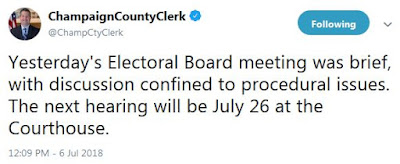
If you follow your County Clerk's twitter feed, you may have noticed that an objection was filed against Cathy Emanuel, a recent independent candidate filing in the race for County Board District 4:

https://twitter.com/ChampCtyClerk/status/1015281704184016898
So, what's going on, and what exactly is an Electoral Board? Well, when people fill out and submit an objection (in triplicate!) to the election authority that oversees a particular election, the appropriate electoral board is the one that considers it. In general: the statewide candidate objections will be heard by the State Officers Electoral Board, county candidate objections will be heard by the County Officers Electoral Board, municipal candidates will be heard by the municipal electoral board, with some rules to cover the oddball edges and special circumstances (all laid out here in legalese in the IL Compiled Statutes).

So at the County level here, that'd be the County Clerk, the County State's Attorney, and the County Circuit Clerk, with the County Clerk chair. Each can designate an assistant to sit on the board in their place. And what, you may ask, happens if the objection is to themselves as a candidate or some such conflict? The law says the County Treasurer or the County Sheriff will sit in depending on the situation/eligibility.

The decisions aren't arbitrary and appear to be guided by law and precedent and subject to judicial review. In fact, if you do a word search through the State of Illinois Candidate's Guide, you'll find numerous references to precedent from Electoral Board rulings.

I'll be updating with further information on whether such hearings are open to the public and if so, how to attend. I'm also looking to see if the records of such hearings are available as well.

Disclaimer: I'm not a lawyer, and this is just my best understanding as a layman. I'll update with corrections and additional information as needed.

Another Step Towards Solar Farms


Solar farms in Champaign County inched closer to reality with last night's Environment and Land Use Committee meeting (agenda here, video will be available from the County Clerk YouTube channel here when available with "Environment and Land Use" in the description.) From today's News-Gazette:
Champaign County Board panel advances solar-farm proposal
...
The Champaign County Board's Environment and Land Use Committee unanimously voted Thursday night to begin a 30-day review period for a proposal allowing photovoltaic solar farms on certain agricultural properties. The proposal would require amending county zoning ordinances...

Similar to a wind farm, a solar farm would require a special permit — only allowed in AG-1 and AG-2 agricultural zoning districts — from the county board...

[Zoning administrator John] Hall said there are seven solar-farm applications pending overall in Champaign County.

Under the proposal, no solar farm would be allowed within any contiguous urban growth area or within a half-mile of any zoned municipality, except as may be necessary to connect to an existing electrical substation.

The proposal also includes protections to existing drainage district tiles.

And if a solar farm is ever decommissioned, the proposal calls for the land to be reclaimed for agricultural use.

Two more steps are needed before the proposal could receive approval:

First, following the 30-day review period, the committee would have to vote to forward the amendment to the full county board; that vote is currently set for Aug. 9.

Then, if approved, the county board could take a final vote at its Aug. 23 meeting.
Full article here. This follows the Zoning Board's preliminary approval of rules for solar farms (more on that here). Here's a background article that lays out concerns about noise, topsoil, and other issues the potential solar farm raised (don't let the "wind" in the title throw you): Sidney resident offers cautionary tale on wind farms.

Thursday, July 5, 2018

Champaign Community Coalition Update

Following up on last week's special meeting on gun violence, seeking community input and action to curb the spike in gun violence this year, the News-Gazette had a blurb about next steps and the upcoming Champaign Community Coalition Meeting next week:

More information on the meeting on July 11th here and more information about the Champaign Community Coalition at their website here. There is also a Cheat Sheet post on the Coalition and even an example meeting write up to get an idea of what they're like here: Champaign Community Coalition.

Economy Roundup: DPI and Airport Concerns


Governor Rauner's awkward apology tour with local officials may have grabbed the most headlines and social media posts of him looking even more awkward on a bus... but a serious economic issue having to do with concerns over the future Discovery Partners Institute may have gone overlooked in the madness. From Sunday's News-Gazette:
Tom Kacich | Gov. Rauner's words bolster nagging fears about DPI
...
But there was more to worry about in Rauner's remarks, that nagging concern that local leaders have about the proposed Discovery Partners Institute in Chicago's South Loop, where the UI is supposed to lead a multi-university research institute. They worry that the talent, leadership and money at the Urbana campus might be shifted to Chicago. Rauner's comments didn't help.

"We can start some companies there" in Champaign-Urbana, Rauner said, "but what we need to do is help the University of Illinois expand in Chicago, expand into Rockford and Peoria, that have large economic systems and great, great companies already ... and a diverse, large workforce and then use their innovation and technology and ability, get their students integrated in the local economy, and we can boom. If we get the U of I to open a campus here down on Roosevelt Road, which is what we're striving to do and get them to partner with UC, Northwestern, Tel Aviv and Technion in Israel, their new partners for this, we can have some of the great innovation and some of the fastest-growing companies right here in the state of Illinois."

Rauner's talk of a campus on Roosevelt Road flies in the face of assurances from others that this would not become another UI campus. And it worries others, like Fox, who think the Urbana campus and community need to be more aggressive in fighting for state support.
More at the full article here. If that wasn't concerning enough, United Airlines broke the bad news this week that they won't continue service here. From Tuesday's News-Gazette:
United cancels service at Willard; pilot shortage cited
Barely a year after Willard Airport added flights from United Airlines, the carrier is canceling service at the University of Illinois-owned facility.

Willard Executive Director Gene Cossey confirmed the cancellation Monday.

“September 4 will be their last day of service for a while,” he said. “At this point, we don’t know what their plans will be after that.”

He blamed a nationwide pilot shortage...

Just last week, area officials touted a 10-year record in enplanements and adding service from United at Willard in countering Gov. Bruce Rauner’s remarks in a radio interview about Champaign-Urbana not being able to retain tech businesses because it had “no convenient transportation” and other perceived issues. (Rauner apologized to C-U officials and is set to visit three area businesses Tuesday.)

The United service appeared to be doing well, adding customers without taking away from American...

In May, Cossey said there’s plenty of demand for new flights and airlines.

“There’s a million people a year who want to fly in and out of our area, and we only have about 300,000 seats,” Cossey said in May.
Full article on that here.

Saturday, June 30, 2018

Building the Blue Wave 6/30


The People's Agenda hosted a Building the Blue Wave presentation and educational community event at the Champaign Public Library on Saturday. The focus was helping those unfamiliar with the nitty gritty of political campaigns and the serious amount of work and energy that goes into getting out more of the vote than the other guys who are working to do the same. For many of us this battle raging with every election, even the elections we missed or didn't even know about, goes on without us noticing. Folks of varying political interest and awareness of the issues can easily miss or ignore a lot of the party apparatus it seems.

The theme of the overall event was the need to put in the work. Like building a lot of things in life, there's not much of a secret to building support for candidates and causes: it takes people putting in the time and doing the work. The presentation talked about what that means, what's effective and how to avoid the pitfalls.

State Representative Carol Ammons started off the event emphasizing the need to put in the work and affirming that complaining alone does not get it done. She put it simply that "we will not win if we don't work." She discussed tips and concepts to be effective in that work. The closing "important point" was probably the most critical: person to person interactions is what gets people to the polls. This can't be done from the couch.

Aaron Ammons, the Democratic Party candidate for County Clerk, spoke about his values and concerns for the County Clerk's role in ensuring the fullest possible access and opportunity to vote for everyone in Champaign County. He made a solid case for progressives concerned about their voting rights in the current political environment to want someone who not only believes that certain Republican tactics can suppress the vote of marginalized communities, but will fight passionately to make sure that their voice is protected and heard too.

Michelle Jett of the People's Agenda then did a brief overview of the local races on the ballot and took some questions that eventually led into the next big topic of the event: actions that people can volunteer for and get connected with people to do the work.

Ann Quackenbush was the next speaker and assured people there that it just takes showing up and doing the work to get started. She explained how she went to a People's Agenda meeting after the 2016 election wanting to learn what she could do. Today's she's an elected committeewoman working to help get other candidates elected. She also explained the valuable roll that poll watching plays in the election process and how people can get more information and involved in that.

There was then a lot of questions and answers on various topics raised, opportunities, and election information from voting to being an election judge. There was also a quick rundown of logistics for people who were planning on attending another event directly after this one.

Carol Ammons ended the presentation on the historic nature of the times in which we live and the critical need for people to stand together and stand up for the vulnerable when they're under attack as it is an attack on us all.

For more information the People's Agenda has a contact form on their website. If you're interested in volunteering and getting involved in the work of winning elections, they have a form for volunteers to sign up here.

The Week Ahead: 7/1 - 7-7

*** July will likely have a lot of cancellations other than the regular County Board meeting. Build Programs Not Jails will not be meeting on July 4th due to there being no CUMTD service that day. BPNJ meetings will resume every other Wednesday starting July 11th. More info below.  ***

Other Events:

There are a lot of political campaign and organizing events popping up. Check out your preferred candidates and you will likely see campaign, canvassing, or voter registration events in the area. Many are using facebook to more easily share event information and reminders. Check out the Champaign County Voter Alliance's preliminary general election candidate guide to see who is running. We'll be updating County race information from the primary election to the general soon.
 
Groups that crossover with Racial Justice Task Force recommendations meeting this week:
Build Programs Not Jails doesn't meet this week. Meetings are usually every other Wednesday at 7pm at the IMC. Due to the July 4th holiday disrupting public transportation, the next meeting is July 11th at the regular place and time. Meetings will continue every other Wednesday, e.g. the meeting after next will be on July 25th and so on.

Champaign Human Relations Commission will be having a special meeting of the officer nominating committee July 2nd at 11am. This may be more procedural parliamentary housekeeping than substantive this month. More information on City of Champaign meeting times here. This commission had previously recommended to the City Council that they remove the exemption to their housing discrimination protections as recommended by the RJTF. 
Later this month — likely at the July 24th Champaign City Council Study Session (more info here) — there will likely be a presentation on the housing issue and the exemption (more information on that here and a recent letter to the editor by the CU Tenants Union here). Support among local organizations continues to grow. The Housing Authority of Champaign County's new Executive Director reaffirmed the board's focus on expanding reentry opportunities in the community and the problems exacerbated when people with conviction histories are denied access to housing. He pointed out that HACC is still working with the Champaign County Reentry Council towards that end and he is reaching out to community organizations and government bodies in the area to work together on that and other issues.

County Calendar:

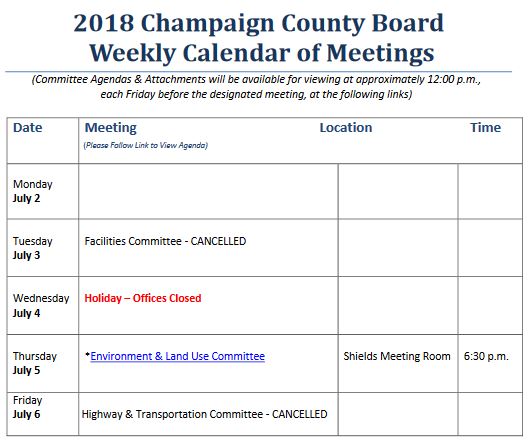
The only thing going on this week other than cancellations and a July 4th holiday closing to report is the Environment & Land Use Committee (agenda here). The committee will be receiving the Zoning Board's proposed rules on solar farms and performing the preliminary procedures to vote on them in August (more on that at this Cheat Sheet post). The Environment & Land Use Committee deals with environmental issues and how land is used within the County's jurisdiction.

The full 2018 schedule is on the Calendar page and the County page. The regular County Board meetings are back to Thursdays until next holiday season.

If you're curious about learning more about how your county government works, it's easy enough to live stream a meeting or go in person: Attend a Meeting.

http://www.co.champaign.il.us/CAL/2018/180701.pdf

*Meeting is broadcast live on Comcast Public Access and at http://www.ustream.tv/channel/champco1776


Where is Brookens?

Brookens Administrative Center
1776 East Washington Street
Urbana, Illinois 61802-4581
Phone: 217-384-3772

After 4:30 the Washington Street side Parking Lot is Closed See Maps for the North East Parking Lot Access


Solar Farm Rules


From the News-Gazette website Friday:
Champaign County Zoning Board recommends approval of solar farm rules
The Champaign County Zoning Board of Appeals has recommended approval of the rules for solar farms in the rural part of the county.

Director of Planning and Zoning for the county John Hall says that the board Thursday night voted 4-2, with Marilyn Lee and Jim Randol voting no. The rules will now go before the Environment and Land Use Committee next Thursday night.

That committee won't vote on the recommendation from the zoning board until Aug. 9th, where it could then be sent on to the full county board.

Hall says that a decommissioning plan was approved Thursday night as a part of the rules, which provides financial assurance, if and when the panels ever need to be taken down.

Some of the other rules include that the solar farms must be a certain distance away from a home, or from a community's city limits, a noise study must be done, and that there must be a road use agreement to cover the costs of damage to rural roads during construction.
Full article with additional details here. Here's a background article that lays out concerns about noise, topsoil, and other issues the potential solar farm raised (don't let the "wind" title throw you): Sidney resident offers cautionary tale on wind farms.

Community Coalition Special Meeting on Gun Violence

I wasn't able to personally attend the meeting Thursday night, but the Champaign Community Coalition highlighted local coverage on their website linked below:

WCIA had a video segment and article available here on their illinoishomepage.net website:
Community meeting focuses on gun violence prevention 

https://www.illinoishomepage.net/news/local-news/community-meeting-focuses-on-gun-violence-prevention/1272530187

There's been a spike in gun violence in the Champaign-Urbana area this year and many are left wondering why.

Thursday night, there was a special meeting to figure out what the problem is and what can be done to make a change.

There have been four shootings the past two weekends in Champaign and dozens more gun crimes have happened this year. City leaders and people who live in both cities are saying enough is enough.

The meeting focused on three main things: People's concerns about the gun violence increase; the strengths which exist in the community for support; and actions to prevent this from happening again.

People shared their testimonies of losing family and friends and stressed why it's critical people put down the guns. It's been one shooting after another.

Preston James says, "People are scared to let their kids go out and play."

There have been 52 shootings and gun violence crimes in Champaign-Urbana so far this year. That's 18 more than this time last year. But the question remains, how can it be stopped?

Champaign County Chief Deputy Allen Jones says, "They have to go away. They have to put down the guns and stop with that attitude that it will solve our problems. We need to make sure that all of us in the community are working together to say no more."

The Champaign Community Coalition called a special meeting with city leaders, police and people who live in both cities to come up with specific solutions to make this stop. Many said people need to understand the consequences of gun violence, both for the shooter and for the people who get shot. 
More information, including the video segment, at the full article here. Fox Illinois WCCU's coverage touched on some other issues and perspectives:
CU to approach increase in gun violence as a "crisis"

http://foxillinois.com/news/local/cu-to-approach-increase-in-gun-violence-as-a-crisis
...
Some concerns focused on legislative and structural faults.

"It starts at the top,” said NAACP Champaign County Branch President, Minnie Pearson. “Violence starts at the top, and we are here at the bottom trying to solve the problem.”

Others, like a mother who lost her son to gun violence in the community, appealed to people’s emotions.

“A lot of them out there shooting, I don't think they know how the parent feels when the parent loses a loved one,” she said. “How the ripple effect go all the way down like a domino. How I feel every day, and you never lose the feeling of losing a loved one."

Next, strategy was put in place.

"We have a resource-rich community, we have the University of Illinois here, we have a lot of resources,” Donté Lotts said. “But why aren't we connecting those resources to the people that need them the most?"

The group brainstormed ways to use the community’s strengths to outweigh its weaknesses.
More information along with another video segment at the full WCCU article here. Friday's News-Gazette article also listed additional ideas raised at the meeting:
Among the other action plans pitched by the group:

— Taking stock of local social services programs and making efforts to avoid duplicating them.

— Having people with a gun-violence history persuade others to avoid the activity, as opposed to people who don't come from that background.

— Encouraging the University of Illinois to provide awards or incentives to employees who integrate themselves and their work in areas outside of campus.

— Advocating for a higher minimum wage that can support a family.

— Getting youth more involved with the effort and asking for their ideas.

— Making room in schools for social service programs to be provided during school time.
More News-Gazette coverage of the meeting and additional information at the full article here. Information about CU Fresh Start at their webpage here and an overview on the Cheat Sheet here.

MTD Budget Increase


Thursday's News-Gazette had some budget numbers for the Champaign-Urbana Mass Transit District from their most recent board meeting:
MTD board approves budget with $10.7 million spending bump
Employee raises, capital projects and a liability insurance increase will help push next year's spending plan for the Champaign-Urbana Mass Transit District up by about $10.7 million.

The MTD board unanimously approved a budget for the fiscal year starting July 1 that includes a total appropriation of $56.4 million — roughly 19 percent more than the current year's $45.7 million.

A public hearing preceding that action opened and closed rapidly when there weren't any comments offered.

Most of the budget increase is reflected in capital spending, according to MTD Managing Director Karl Gnadt. That's largely linked to the MTD's hydrogen-fuel-cell project, of which a Federal Transit Administration grant is covering $1.45 million of the cost, he said.

The MTD expects to take delivery of two no-emission, hydrogen-fuel-cell electric buses by early 2020, Gnadt said.
More details, like a 2.75% raise for everyone, fares being unchanged,  and a breakdown of other spending priorities at the full article here. A quick overview of the grant announced jointly by Congressman Rodney Davis and CUMTD last year here. More information on the hydrogen fuel cell project from its page at the Center for Transportation and the Environment.

New Fake Weed or Meningitus Concern


The Champaign-Urbana Public Health Department had a couple updates this week about fake weed / bleeding issue affecting the State not popping up in our area (following up on an April post). From this past Wednesday's News-Gazette:
State seeing more reports of bleeding linked to fake pot
More cases of severe bleeding in Illinois have been linked to the use of synthetic cannabinoids.

Most of the new cases occurred in Winnebago County, and Wisconsin has also reported cases, according to the Illinois Department of Public Health.

More than 160 people in 14 Illinois counties have experienced bleeding from the use of fake pot, which is also called K2 and Spice. None of the cases have turned up in East Central Illinois counties to date, according to the health department.
Full blurb here. A meningitis case in Vermilion County was not the highly infectious variety that can cause medical alarm, especially in a college town like ours. It wasn't even a type required to be reported to public health agencies, though it can be just so everyone is aware what's going on. More on that from same paper:
Rare, nonreportable form of meningitis blamed in Danville woman's death
The Vermilion County Health Department said it wasn't notified about a fatal case of bacterial meningitis earlier this month because it wasn't a more common bacterial form of the disease that medical providers are required to report...

With both viral and bacterial meningitis, people experience symptoms such as headache, stiff neck and low-trade fever, but those with the more common viral meningitis generally get better in a few days. Bacterial meningitis can progress to become life-threatening.

Toole said the last case of bacterial meningitis involving the bacterial strain Neisseria meningiditis in Vermilion County was in 2011. Neisseria meningiditis is the culprit behind meningococcal disease.

Vaid said local hospitals typically report any case of bacterial meningitis to the Champaign-Urbana Public Health District, even if they're not required to do that, if they see something unusual or are waiting on lab confirmations about a suspicious infection. In Ms. Kiley's case, her Carle caregivers knew the source of her infection through testing, he said.
Full blurb here

Carle Roundup


This week there were a few stories where Carle and local government intersected. From mobile clinic programs mentioned in their presentation to the Champaign Community Coalition last month, to news about the Carle Auditory Oral School, back to the property tax disagreements that always seem to be in the background.

First on the mobile clinic. From Tuesday's News-Gazette:
Carle launching mobile health clinic to target neighborhoods in need
...
The care provided in the mobile clinic won't be free, but everyone will be served regardless of their ability to pay, she said.

The mobile clinic will accept health insurance and Medicaid, and the uninsured who can't pay will be linked to Carle's financial-assistance program, she said.

Researchers found the most disparities in health outcomes locally in the Garden Hills area of Champaign, but other pockets in the northern corridor of the community have also been identified for it to target down the road, Sellett said. Carle plans to partner with schools and churches to secure locations where it can park, she said.

Health disparities are caused by a number of factors, among them where people live and environmental factors that can lead to disease — plus social inequities such as differences in behaviors, access to health services, economic status and literacy levels, according to the National Institute of Environmental Health Sciences.

In fact, just 20 percent of a person's health is a result of what's in their DNA, Sellett said. Another 30 percent is linked to the kinds of day-to-day decisions — good or bad — that a person makes, and the other 50 percent is tied to social and environmental determinants, she said.

The mobile health clinic is being made possible through donations of Carle and Health Alliance Medical Plans employees, proceeds from the 2017 Carle Golf Open and other donations, according to Carle.
Full article here. Also a brief summary of their Healthy Beginnings presentation at the Community Coalition:
They are developing a 20 year plan that ranges from individual care through interpersonal, community and organizations all the way to policy towards ensuring access to health care resources. They are currently embedded in the Garden Hills community and hoping to bring in a mobile medical unit and other resources such as education opportunities to the community.
On Wednesday the News-Gazette highlighted the Carle Auditory Oral School:
At Carle's school for hearing impaired, graduation day full of sounds of success
...
Those graduating are usually children who are introduced to sound at an early age and have access to intervention before their third birthday, said CAOS Director Danielle Chalfant.

However, no matter what stage the child is in during the learning process, the program will always accept new members, she said.

"We meet children and families where they are," Chalfant said. "There are a lot of programs that base a child's eligibility on whether they can make their hearing disability unnoticeable in two years. We don't do that."

Chalfant, who has been at CAOS for 20 years, said money has never been the decision-making factor when considering a child for the program. A scale based on income and family size is used to make sure all families can have access, she said.
Full article here. And finally on property taxes, the News-Gazette had the latest information in their Friday edition. These quick excerpts only highlight a couple of the arguments made while summarizing the issue. The full article gives a better overall look at what the dispute is about and what both sides are arguing. It honestly makes my head spin a bit:
Carle attorney: Property-tax fight based on 'dead wrong' assessments
Former Cunningham Township Assessor Joanne Chester was "dead wrong" when she assessed the full values of four key Carle properties more than a decade ago, one of Carle's attorneys contended at a lengthy court hearing Thursday...

His arguments — and those from attorneys representing state and county taxing authorities — were raised in the hearing before Judge Randy Rosenbaum, which ended with the judge taking it all under advisement.

He'll likely issue a written ruling at an unspecified later date, he said.

What Rosenbaum is deciding is a motion originally filed by Carle last August seeking a judgment that would effectively open the door to it receiving refunds on property taxes it paid from 2004 to 2011 on four Urbana properties — Carle Foundation Hospital at 611 W. Park St., as well as its facilities at 809 W. Park St., 503 N. Coler Ave. and 607 N. Orchard St.

Carle paid $20.7 million in property taxes to local governments under protest on those properties...

Fletcher further argued that Carle waited an unreasonable amount of time to bring its claim based on a wrongful failure of taxing authorities, and that the delay caused an unfair damage to taxing districts. The loss to the county alone, should Carle prevail, would be more than $1.4 million, he said.

Fred Grosser, the attorney for the township, township assessor and Urbana, said Chester had learned in 2003 from the Department of Revenue that she hadn't been properly assessing properties that had previously been determined to be exempt or partially exempt and, based on that, made a change in her procedures.

One of the problems with Carle's claim is that none of the four properties had been in exclusive charitable use, and they'd qualified only for partial exemptions, he said.
More at the full article here.

Friday, June 29, 2018

Housing Authority 6/28 Meeting

 The June Board of Commissioners meeting was an overwhelmingly positive affair (agenda here). First, a couple highlights: Apparently these meetings are being broadcast on Urbana TV (website here, live streaming here). I haven't found any previous videos on-line, but I'll update if there are any on demand options available.

The Executive Director reiterated his commitment to improving housing opportunities for those reentering the community from the criminal justice system and working with local organizations and government towards that end. He mentioned specifically meeting with Esther Patt of the CU Tenants Union on the subject. She had a letter to the editor explaining her concerns in the News-Gazette yesterday as well. Previous post on the City of Champaign rule here.


Meeting Write-Up

Commissioners Adair and Rose were absent. Commissioner Walker arrived a couple minutes after the 3 o'clock start. The agenda was approved and public comment on agenda items was offered with no takers. I didn't quite follow what was going on with the minutes, but the agenda had a note that they'd be approved next month.

New Business
There was a vote moved until after closed session (5.a. of New Business on the agenda) to allow the full board to vote on the motion with additional information from conversations the new Executive Director had with some of the players involved in those sale and lease agreements.

The land swap with the Atkins group had a last minute change from the verbal agreement to after it was approved by their committee. The additional cost was described as shocking and upsetting, but still within the realm of being a positive deal for the Housing Authority. From the memo (on page 23 of the agenda packet file):
After the April board meeting we confirmed with the Atkins Group that we were in agreement with their request for the land  swap, exchanging the Newton Drive site for the Interstate Drive site. Jean Kenol has been working with their attorney since that time.

On Tuesday, we received an e-mail indicating that they would only proceed with the swap for additional compensation. Needless to say, we were shocked, that at the last hour, they presented a different deal than what they had previously resented and that we had been working on finalizing for weeks.

We really have no alternative at this point, we have  ompleted all site design, financing applications and HUD applications based on the  Interstate Drive site and we have to meet critical deadlines with HUD and for the sale of Skelton. In  looking  at this  more  calmly,  even  with  the additional compensation, it is still a good deal for HACC.
Northern agreed with that assessment. Commissioners Turnbull and Henry advised caution in the future and to consider ways to avoid sending a signal that sellers can pull stunts like this in the future. The swap was approved unanimously. All votes today appeared to be by roll call and unanimous as far as I could tell. Everything on the agenda passed prior to the closed session. I don't know how the resolution moved to after that fared.

Additional work on one of their RAD construction projects was approved for improvements not in the original plan and some added expenses while having to work around tenants being moved around.

A revenue generating project at Oakfield Place in Henry, IL was discussed with benefits and risks and guarantees of operating expenses if there are losses. It fills a demonstrated need in an area without its own Housing Authority and will provide funds for HACC projects. The resolution passed moves forward on the project by authorizing the ratification of an agreement and a payment of a reservation fee, etc.

An intergovernmental agreement with Urbana was passed for supportive housing for people with special needs in Urbana and working with the City of Urbana. Danielle Chynoweth thanked the Board and staff for its work with the City on this issue and explained a specific housing crisis and barriers between disability benefits and affordable housing available. An additional resolution to option the property involved in that agreement also passed.

A resolution approving the financial closing of the Bristol Place property passed. This covers all the needed resolutions and authorizations to finish the deal now that the City of Champaign Council approved what needed to be done on their end.

Reports
The Executive report was introduced by the Chair who took a moment to thank the new Executive Director for hitting the ground running. Northern played a promotional video for a senior housing project in Mahomet (available on the HACC YouTube channel here). It attempted to address both the need for more senior living options as well as concerns that arise in many communities by the ideas they may have about public housing.

Northern then discussed many of the meetings he has had since starting as the new director, from local police, community meetings, the CU Tenants Union, and so on. He described a major initiative to reach out and build relationships with the community. When discussing working with the U of I he mentioned a recent project with their Fab Lab Summer Camp he thought might be a good match for some of their communities.

He talked about needing to use the tools available for transparency to address community concerns. He also discussed constituent services to address concerns and complaints from tenants in a more organized way. In response to questions by Chynoweth he said this wouldn't be a new office, but part of the duties of the executive office.

He mentioned that he was going to check out the CU Fresh Start program at a meeting tonight (latest on their Call-ins here). He said to all those listening that if he hadn't met with you already, you're on the list. He'll be meeting everyone.

He also brought up a Lifetime Achievement Award from Lake County for his 24 years working in housing. Turnbull mentioned positive mentions about the new director from their communities. He spoke of setting aside vouchers and working on other ideas for reentry in response to Chair Lewis asking for his thoughts. He pointed out he's focused on the subject and working with the Reentry Council. He pointed to the problem with stigma and explained that we're all human and we all know people who've been through the system. He described this board as being on board and him being on board to improve opportunity for reentry. Turnbull suggested looking at all parts of reentry with the Housing Authority again to look for solutions and options.

The departments then gave their reports. Some highlights included a discussion about the time it takes to move people through emergency shelters to supportive units which are permanent housing. One issue is power and water bills that have to be in the resident's name and requires past delinquencies to be resolved through payment or relevant programs. How to start that process earlier was being looked at to avoid unnecessary delays.

Issues of vacancies and difficulties for those on extended waiting lists to maintain paperwork, contact information, etc over a two year period were discussed as well as intern possibilities through the U of I and Human Service Council. Training for job skills and retention were discussed with Turnbull recommending an option for professionalism training. Facilitating appointments more, as opposed to just sending folks out who may get overwhelmed or fail to connect to the services they need was mentioned as a strategy going forward.

Bed bug eradication and prevention was discussed. Screening for new furniture and protocols for tenants being moved due to construction were described. Orken has "bed bug smelling dogs" that can identify infected units without disruption to target those and neighboring units for treatment. Unfortunately there appeared to be a general dismay at how pervasive they are. One person said he no longer buys upholstered furniture, the director talked about special suits he had to wear in the past, and one staff member said the Housing Authority may never get rid of them altogether.

In an update on the audit, it was reported that the folks performing it will be finishing it up tomorrow and that there will be a presentation in July. The audit is due in September.

Wrap-Up
Northern pointed out that they're still looking a buyer for the HACC building (the one we were sitting in for the meeting on Park) and he thanked his assistant. The general public comment appeared to be introducing a new employee.

The board then went into closed session. I wasn't able to stick around for the vote afterward.