Showing posts with label CUMTD. Show all posts

Tuesday, June 9, 2026

June Champaign County Updates

There is a separate post highlighting some of the local Juneteenth events, as well as some other event information for June and in general here.

Issue highlights:

Gun Violence: There have been numerous incidents of gun violence in recent weeks. The Police Chief Updates at the June 10th Community Coalition meeting will likely be the best source for more general updates. That meeting starts at 3:30pm, but will also be available online as early as the next day at this link.

Homelessness: Both the City of Champaign and the CSPH (Champaign County Continuum of Service Providers to the Homeless, operating out of the Regional Planning Commission) are developing strategic plans on the issue. The CSPH process involves the national consulting firm Homebase and is working towards “a community-wide plan to achieve functional zero homelessness by 2028.” 

A draft version of the City of Champaign’s Homelessness Prevention Blueprint was included in the Study Session report on May 26th (starting on page 32 of the report here). The City’s planning already includes a proposal for a new “homelessness and community services manager” position. The position and its duties are expected to evolve, with decisions on permanently funding the position after the initial three years. I’d expect the final vote(s) on the finalized blueprint to happen with the Fiscal Year 2026/27 budget votes this July.

Aging Care: There will be a public hearing on an application by Advocates for Aging Care for 120-licensed skilled nursing beds, as part of its efforts to address the local need. The hearing will be held at the Savoy City Council Board Room (611 N. Dunlap) on Tuesday, June 9th from 1:00-4:00 pm. Those wishing to submit a letter of support must submit them no later than June 20th. AAC's flyer is information, regardless of your views on the topic (click to enlarge):

Champaign County Health Care Consumers has a lot of additional information on the project being proposed and discussed at this Public Hearing here

Champaign County Government:

The state bill restricting data centers, known as the POWER Act, is reported to have stalled, at least for this legislative session. This was discussed in the latest Data Center Activities Task Force meeting earlier this week. Last month’s report noted that the county passed a 12 month moratorium on so-called “hyperscale” data centers that are a major source of concern, especially its impacts on the aquifer and power supply. Unfortunately both could still be negatively impacted by any data centers built near Champaign County without more state regulation.

While some local government bodies have their Fiscal Year starting in the middle of the year (with many budget discussions happening right now), the County's Fiscal Year mirrors the calendar year. Here's a quick reminder of the County Budget process and timeline:


We don't have a lot of updates this month, as we're hoping to collect more information on the delayed audit and other issues during this month's meetings (see our May updates for more on that). Hopefully we can have some more helpful information in July. 

Other Government:

MTD: Last month’s report pointed out that the C-U MTD board will redo its annexation votes for areas that would allow a link for local bus routes to Carle at the Fields in Southwest Champaign. There appears to have been a technical violation of state law that prohibits meetings on election day (one of the public hearings for the annexation fell on the day of the March primary). There will be new Annexation Public Hearing on Monday, June 22nd at 5pm, held at Curtis Road Church of God in Champaign

Wednesday, June 28, 2023

County Public Transportation Updates


WARNING: This post may use and link to references heavy on abbreviations and local government jargon. The Champaign County Regional Planning Commission has a handy abbreviation reference list (with agency names at the bottom) here.

At the last County Board meeting, there was a long explanation of the bureaucratic hurdles and timeframes that can undermine perfectly good projects. In this case, installing some public transportation shelters in Rantoul as part of the rural transit program here in Champaign County (jump to video link of the presentation here). The presenter who goes into great detail about the regulatory steps and timelines was Rita Morocoima-Black, Planning and Community Development Director at the Champaign County Regional Planning Commission (RPC).

RPC's website has a basic description of that function:

The Regional Planning program of RPC provides planning-related technical services to local governments throughout its service area. These services include a range of programs which address policy analysis, planning processes, demographic, economic, environmental and geospatial information analysis, and technical analysis. Most services are either contractual or funded and governed through intergovernmental agreements.

If one goes to the committees and meetings page of the RPC website, they'll find that the Regional Planning Commission is primarily made up of representatives of local governments: village presidents, mayors, the Champaign County Executive, etc. It has a long local history, especially with transportation planning, and now has multiple divisions and works to coordinate intergovernmental agreements and programs across the area.

You'll hear RPC mentioned a lot in local government meetings because it is often at the center of programs that run across government jurisdictions. This is, of course, a very common occurrence in any county dealing with local units of government, but especially in counties with "twin city" population centers.

You'll also hear the long RPC acronym for transportation planning thrown around a lot in this context: CUUATS. I'm pretty sure only the people who work at CUUATS (and not even all of them) can readily ramble off what it stands for with 100% accuracy. If you have to google it, every time, you're not alone. It stands for Champaign Urbana Urbanized Area Transportation Study and also has a long history within the RPC.


But the County Board Agenda said "Rural Transit Advisory Group"

This County Board presentation, for example, was a presentation on the Rural Transit Advisory Group, which was established by the county to oversee the collaboration between the Champaign County government and the MTD (local mass transit district) for County wide and rural services. In basic terms, the County gets public transportation funding for services around the County and works with MTD to provide many of the services.

In the complicated realm of federal grants, Illinois Department of Transportation regulations, and working across various local government bodies and transit districts, this is only one piece of the puzzle, however.

Rita Morocoima-Black wears many hats in this bureaucratic overlap. As a recent CUUATS agenda packet points out, she's variously listed as: 

  • Planning and Community Development Director for RPC (the overarching planning commission in Champaign County)
  • Transportation Planning Manger for CUUATS (the transportation planning group within RPC)
  • Also acting as bit of a liaison with the County's Rural Transit Advisory Group (RTAG).

At the heart of all this is transportation planning. In spite of all the acronyms, committees, and paperwork, this is all about connecting real funding to real transportation projects.

When you're dealing with federal, State, County, and local government bureaucracies all operating with their own tax bases, regulations, and authority, however there's not just simple agreement. The written agreements tend to establish a working relationship to protect the interests of everyone involved. They're often heavily scrutinized before and after, especially if voters or an interested party think any tax money was wasted or mishandled!


Staying Informed

Unless it's your job or you have a lot of time and coffee, the average voter couldn't possibly keep up with all of the details and meetings involved with just these organizations and related boards, committees, and groups. And that's just for the County's public transportation planning, funding and spending. 

You have to choose your level of interest and commitment to this issue:

  • If you simply follow the County Board meetings, you'll get very general updates from all of these commissions and groups from time to time. And that's probably enough for your average voter.

  • If you're more generally interested in area transportation planning and budgets, you might consider going through the CUUATS Policy Committee (remember, the transportation planning group within RPC!) documents or even attending one of their meetings.

  • And if you're extremely interested in public transportation policy within Champaign County, you can also follow the CUUATS Technical Committee meetings and documents as well as the MTD's own meetings and documents that include their C-CARTS program and even more glorious acronyms. The Champaign-County Area Rural Transit System or C-CARTS is a real public transportation system at the end of all this planning, funding, agreements, and appropriations.
And of course that's just where you might start on this particular issue. For more specific concerns about rural public transit in this town or the other, you might have your own local committee, commission, or village group to work with!

If you live in Rantoul and really want to find another funding path for building those public transportation shelters at June's County Board meeting, hopefully this post helps a little!

[UPDATE 6/29: The MTD Board also approved the intergovernmental agreements with the County on their side at their 6/28/2023 meeting. That is covered on a Cheat Sheet C-U Local post here.]

Thursday, November 4, 2021

October County Roundup


There was a lot going on at the County level this month. I'm still not caught up with the latest on the Jail discussions, but there are links to last night's meeting below. Redistricting and budgeting priorities once again dominated the conversations.

The News-Gazette had coverage of the discussions going into the federal relief funds (ARPA) and how the various Board members were prioritizing plans from progressive projects to local facility needs. Excerpt from the News-Gazette coverage earlier this month:

While board Democrats are noting the categories of projects they want to prioritize, specific projects within those categories will need to be studied before projects can proceed, Patterson said.

A substantial amount of the federal money will be spent on county facilities, he said, and while the jail is one of those facilities in need of attention, it’s unlikely that a large portion of the $41 million would go toward a jail project...

Republican board member Brad Passalacqua said Republicans haven’t drafted a formal proposal for where the $41 million should be spent, but have made their views known at public meetings.

Republicans support a significant amount of the funds going to solve some of the problems with the county jail in downtown Urbana and the satellite jail and for much-needed broadband infrastructure throughout the county, he said.

That full article here. WCIA had a more extensive look at the jail consolidation needs and cost issues earlier in October here. There was a Jail Facilities Committee meeting last night, but I haven't had a chance to review it yet. The video is available here on the County's YouTube channel.

In addition to the latest jail discussion updates, the Board approved funding for two more Sheriff's deputies. Republicans had pushed for adding funding for four more deputies during the debates on budget and need. Excerpt from the News-Gazette coverage prior to the regular Board meeting vote:

Heuerman said his recommendation would be to add four deputies, but he welcomed the addition of two more.

“We could always use more deputies,” the sheriff said Wednesday. “I could absolutely use the four.”

The additional two deputies had been negotiated as part of the budgeting process with County Executive Darlene Kloeppel based on what money the county has available, he said.

Heuerman said adding two deputies will cost the county $242,000, including salary, benefits, equipment and training.

That full article here. WCIA's coverage, including a video segment, also noted the Sheriff's hope that the additional funding for two more deputies may come with the next budget.

Another big issue this month was finally working out the last details of the County Board district map with the late census data. The delayed census meant that the various proposed maps were working off of estimates to meet the usual deadlines. There was a lot of fighting within the local Democratic party in addition to disputes with the Republicans leading up to this point. The final map was approved over the objections of the Democratic County Executive and Republicans on the board. The News-Gazette had the map and coverage of the disagreements. Excerpt:

[County Board member Jim Goss] said Friday that while Democrats did their job in coming up with a map that equalized population variance among districts, this latest map also leaves his district, District 1, with an area of 388 square miles.

“It’s just ridiculously large,” he said.

Under the new map, seven board districts favor Democratic candidates, three favor Republicans, and one, District 5 in northwest Champaign, is a toss-up.

That full article here. The News-Gazette also had an article previewing this month's map debate here. Illinois Newsroom had coverage of the latest map approval here.


There was a Victory over Violence town hall and panel discussion including local activists, organizations, and the Champaign County Sheriff. The full video is available on the Champaign Government TV channel online here.


The News-Gazette also had an overview of the history and latest updates on the Champaign County Crime Stoppers program. Excerpt:

Today, the process is significantly more sophisticated.

When calls come in, they’re routed to a company in Canada called Northern Communications, where identifying information is stripped. A random number is then given to the caller, who is answered by employees of a company called Alternative Answers. Information is taken down and recorded in an app called “P3 Tips.” Tipsters can also submit directly to the app or at champaigncountycrimestoppers.com.

The fact that calls are routed to Canada is not random happenstance. Canadian law protects the information that might identify a tipster, Geoff Coon, the agency’s current law-enforcement coordinator.

That full article here. WCIA reported that there were some unusual thefts of weather research equipment highlighted by the Crime Stoppers program this month here.


There were many other County items in the news this month as well:

Wednesday, June 30, 2021

Catching Up - June County Updates


Sometimes the Cheat Sheet gets behind and we have to catch up. The process involved can be helpful to anyone wanting to get caught up on what's been going on at the County Board and other County government bodies lately. Over the last few years we've attended and watched endless local government and organization meetings with notes filling up the filing cabinet. When we don't have anyone available, we have to play catch up, and we start with the local press. To jump to information on other resources, click one of the links below:


Local Press:

The local press can be complicated for activists on various issues or political ideologies, but as a general rule I'd encourage supporting the local paper. For those with serious grievances, one might have to rely on access through their local library's online tools. For most people, a simple key word search for Champaign County Board on the website will do (sorting by "start time" so you get recent articles as opposed to years ago):


You can usually get more hits by searching from within the News-Gazette's eEdition tools, but you'll have to skip over a lot of Section D legal notices too! Here's a list of County Board articles and updates in June:

There's almost always some hidden gems in the search results that might not appear related to the County Board in the preview text. There's usually an article or two related to County government, if not necessarily County Board business:
  • Barbara Scott, a former elected Champaign County Board member, died.
  • Jonathon Westfield died. He was active in local politics, a former police officer, and criminal justice issues including coordinator at the Youth Assessment Center.
  • There was a profile of Champaign County Auditor George Danos.
  • And there was some concern over profanity at a board meeting and YouTube rules addressed in an article and a letter to the editor.
The May and April County Board updates are covered in a separate post here.

Other local news sources can be more hit or miss on something as specific as the business of the local County Board, but tend to pick up other angles on bigger news items or additional news not picked up by other outlets. WCIA has a "Champaign County" local news page here where you can keep loading articles further back in time or a simple keyword search. For example, from WCIA's coverage in June:

Other area television news stations include WAND and WICS/WCCU which often have some local coverage in Champaign County. WAND's search function is similar to the News-Gazette website. WICS's Fox Illinois web search feature is a bit more limited and will mix in some older results relevant to the keywords as well. For June there was a County government related story worth noting from WICS here:

Between the local newspaper and one of the local tv news station searches you'll probably get a decent gist of what's happening when checking out the agenda of the next County Board or committee meetings you're interested in.

There is almost always more out there if you've got the time or have another preferred local news source. Some good examples of sources we cite regularly here on the Cheat Sheet include the Daily Illini, Smile Politely, and Illinois Newsroom / WILL. Here's some County news item examples that pop up in basic keyword searchers in June:

As you can see, broader search keywords (e.g. Champaign County) on these websites will pop up other local government bodies and issues from the MTD to the Forest Preserve to the Housing Authority. All of which have unique relationships and collaborations with local government, funding sources, and governing bodies.

Of course the most comprehensive source of information about the County Board and County government is directly from the source.


County Board and Government Resources:

Meeting information, including agendas, agenda packets, minutes, etc are available on the County website here. We have some basic information on the overall structure of the County government under the Executive Form of County Government here. The general flow of County Board meetings each month tends to start with committee meetings where a smaller group of County Board members look at a set of issues and items and make recommendations or move resolutions towards the full board for a vote. The Committee of the Whole meetings are generally the next step where all the committee and other resolutions before the board are either moved to the full regular meeting of the County Board for a final vote or discussed, amended, etc.

The regular County Board meeting tends to pass uncontroversial items with unanimous support from the Committee of the Whole before moving on to other votes that can be contentious or pass fairly easily. Certain votes, like budget votes that increase spending, can often require a supermajority to pass.

June's regular County Board meeting agenda packet is available here. The most recent videos of the County Board meetings are available on the County's facebook page (and later the County Clerk's YouTube channel here after it is processed). The June regular County Board meeting is available here.

Even with the beginning of the meeting cut off, the video of just this meeting is over two and half hours long. For folks with limited time, jumping to agenda items of interest can be a bit of a guess and test. I have a process of jumping ahead and listening to hear which agenda item the Board is on to see if I jumped too far, or not far enough.

The debate on the mental health funding resolutions begins just before the 1:42 (hour:minute) mark on the facebook video here with a reading of the first resolution. The resolutions were discussed and voted on together. Both required 15 votes to pass. The agenda had a long description of the item purpose:

This [American Rescue Plan Act (ARPA)] funding will be utilized by the CCMHB to expand grant funding for local agencies providing mental health and substance abuse treatment services to individuals and families in Champaign County. This expanded grant funding will allow local agencies to continue to strive to meet the growing need for these services in Champaign County. The CCMHB grant year runs from July 1 through June 30. In order to provide consistent, uninterrupted grant funding for these local agencies throughout the entirety of the upcoming grant year, 50% of the ARPA funding will be utilized from July 1 through December 31 of FY21. The remaining 50% of ARPA funds will be utilized from January 1 through June 30 of FY22.

The debate and discussion revolved around the timing and a disagreement about why this specific ARPA funding needs to be approved so quickly compared to other funding to be discussed in future meetings. This approval would only be for a small percentage of the overall funding, but related to programs and grants that need more immediate funding. It failed mostly along partisan lines with Democrats in support and Republicans opposing.

A deeper dive into the details of this resolution and the programs involved is available in the agenda packet on pages 98-122 (pages 103 through 127 of the PDF).


County Board Members:

Beyond the arguments you might hear in the County Board and committee meetings themselves, County Board members are generally happy to explain their votes and positions on issues from previous meetings. You can contact them from their contact information on the County website here and district maps on the County Clerk's website here (currently more up to date than the Cheat Sheet with Samantha Carter joining the Board). If you follow them on social media, you might get long arguments on various subjects or links to more information and resources.

Often Republicans and Democrats will simply complain about the other being partisan or political, like Board member Jim Goss criticizing the Democratic majority's redistricting vote last month. This month Democrats complained about the Mental Health care vote, such as on board member Jennifer Traub's public facebook page that took issue with a few Republicans leaving without putting their name to a no vote. Board member Samantha Carter echoed the frustration on her own public page and shared a longer criticism of the Republican no votes and not voting.

One can sometimes find some public comments or even extended arguments by board members on various local social media groups and neighborhood apps as well.


Other Organization Meetings:

Following up with the various impacted organizations and communities related to or directly affected by County Board votes is probably one of the more difficult and time consuming end of catching up on County Board business. It's also probably one of the most important. It'll be interesting to see if there's any discussion on this contentious funding vote in the upcoming Mental Health Board meetings next month at the end of July. 

The previous MHB meeting in June, just prior to the regular County Board meeting had some discussion on the violence in the community as it relates to mental health starting with MHB President Joseph Omo-Osagie and then Executive Director Lynn Canfield at around the 9:15 mark in the meeting video (agenda available here). Lynn Canfield's report directly addressed the County Board resolution, the doubts about whether the vote may succeed, and what that may mean going forward.

Follow up on the rural broadband issue will likely be simpler to follow up as the Board works through the issue in study sessions like the one last night (agenda packet available under the Committee of the Whole page). That meeting video (the first fully in person County Board meeting since the pandemic) is available here. It has presentations on the County's role in broadband expansion, groups and service providers with introductory information on the topic. This is working towards work that will be done by the "broadband committee" going forward.

It's definitely a challenge to keep up with all of the various local government and organizations related to local government on the County level and the C-U Local Cheat Sheet. The goal is still to help make it easier to stay informed and involved in your local government.

Saturday, February 8, 2020

Hospital Property Tax Dispute Update


There was a big ruling with one of the hospital property tax cases that have been lingering over local governments of Champaign County for years now. The News-Gazette had initial coverage on their website Wednesday night when the ruling came down:
The Carle health system has prevailed in a 13-year-old legal quest to win back its charitable tax exemptions on four Urbana properties, among them Carle Foundation Hospital.

In a lengthy written opinion issued Wednesday, Judge Randy Rosenbaum found that Carle was entitled to partial tax exemptions on the properties for seven out of eight disputed years, 2005-11, and ordered the Champaign County treasurer to issue Carle a tax refund of more than $6.2 million.

The city of Urbana, Cunningham Township, several local taxing authorities and the Illinois Department of Revenue — all defendants in the 2007 suit filed by Carle — were further ordered to pick up the tab for the cost of the litigation, excluding Carle’s attorney fees.
Full article available here. Thursday's News-Gazette eEdition also has a basic timeline, going all the way back to 2004, explaining how we got to this point with Carle and the property tax disputes here (subscription). Today's paper had a breakdown of the amount owed by the individual taxing bodies:
The amounts the other six taxing districts will owe include:

— Champaign County: $1,481,897.

— Champaign County Forest Preserve: $156,913.

— Parkland College: $967,414.

— Cunningham Township: $367,295.

— Champaign-Urbana Mass Transit District: $517,467.

— Champaign-Urbana Public Health District: $208,589.

While the refund must be made by the treasurer’s office, Weibel said, the money to cover the check will be coming from the seven taxing districts.
That full article available here which also had some initial response from the County Treasurer. Here's another updated News-Gazette article with a response from the Mayor of Urbana:
“We have long contended that Carle Foundation Hospital should support the health of the community in which it is located by paying its fair share of costs for public safety, infrastructure, schools, parks and other core services,” she said. “We believe that the cost of medical charity care for a service region of 1.4 million people should not be borne by taxpayers in one small city of 42,500 people.”

Marlin said the city will be considering its options going forward, but she wants to set Urbana taxpayers’ minds at rest that this ruling won’t affect Urbana’s tax rate and city services. Carle’s tax payments over the years that are now subject to a court-ordered refund have been set aside, she said.
That full article here. More on Urbana's statement on the ruling from WCCU here. WCIA had even more on how the City of Urbana was prepared for the worst here. How exactly this well affect the County and what it means for other hospital property tax exemptions and the budget, I'm not entirely sure yet. The topic has come up before on the Cheat Sheet in regards to the County's financial ratings and outlook and in long term budget concerns of the County board.

More on that to come...

Tuesday, April 30, 2019

League of Women Voters: Observer Reports


The last League of Women Voters meeting was a series of their annual Observer Reports. The reports are available from Urbana Public Television's YouTube channel here:

Here's a list of links to the government entities covered and the LWV reports on them:
A couple highlights for people looking for appointment opportunities. The Urbana Plan Commission had a recent vacancy, though I don't see it on the Urbana Mayor's list of open commission seats here. I don't know if that means it has already been filled or just isn't listed yet. Another position will be opening up on the Urbana & Champaign Sanitary District, including its very controversial pay schedule, in June. Those seats are appointed by the Champaign County Board with more information on that here.

For more information on the League of Women Voters of Champaign County, visit their website and check out their annual meeting coming up this Saturday, May 4, 9:00am - 1:00pm, St Matthews Lutheran Church on Philo Rd., Urbana.

Monday, April 1, 2019

Measles Outbreak Update

[UPDATE 4/1/2019: The last update on the measles outbreak we had was good news about no new infections, people being able to leave quarantine, and waiting to make sure no new symptomatic people/cases popped up. That deadline has passed and the outbreak is officially over. The News-Gazette had a short article here. Relevant excerpt:
The Champaign-Urbana Public Health District waited out two full 21-day incubation periods since the onset of the last measles case before closing the book on an outbreak that included more than two dozen people being quarantined and more than 1,000 people being interviewed after being potentially exposed to the disease.

With no new cases in 42 days, district communicable disease investigator Rachella Thompson-Brown said the Champaign County outbreak can be considered over as of this past Monday.

In all, the measles outbreak that began in the county in January included four confirmed cases. Others quarantined had been exposed to measles and couldn't verify their immunity.
More at that article here. Today the News-Gazette had additional information about there already being more U.S. measles cases in the beginning of 2019 than all of last year. More on that here.]


The local measles outbreak appears to be mostly over as the last quarantined cases of exposed people failed to develop symptoms. The official end of the outbreak is defined a bit further into the future if there aren't any new cases. From the News-Gazette today:
Measles, cabin fever both stayed away during Mahomet woman's quarantine
...
Susi was one of 26 people quarantined during the Champaign County measles outbreak that began Jan. 19. She and others who were the last people remaining in quarantine were free to leave their homes as of today after going 21 full days without developing measles.

The health district won't officially declare the measles outbreak over until later this month, after two full 21-day cycles have passed following the last known exposure date, Feb. 11. That's provided that no new cases develop in the upcoming weeks.

Containing the measles outbreak to four cases has been a labor-intensive effort for health officials, local medical providers and others, according to Julie Pryde, the public health district's administrator.

It included identifying and making public all the public places the four measles patients had been during the eight days they were considered to be infectious — four days before a rash appeared and four days after — and interviewing more than 1,000 people who had been exposed.
Full article here. It gets into more details about the expenses that went into the process and future estimates of how much the outbreak cost taxpayers. It explains the difference in terminology between "isolation," or isolating people who are sick with an infectious disease and the more rare quarantines. Quarantines separate people who may have been exposed to an infectious disease to wait to see if they become ill. There's also additional facts and myths about vaccines, what constitutes an outbreak, and how measles spreads and its dangers.

The above is the most current update, though there were a couple updates in the past month when this website wasn't updated. For people interested in the chronology of the outbreak and public information on cases, testing, and statuses here are the dates and links:

There were a couple other related news items on vaccines and infectious diseases unrelated to the measles as well:
  • A national shortage of the vaccine for shingles is having an effect on local supplies. There are shortages causing intermittent interruptions in availability at locations in town: The Health Reporter Is In, Feb. 14, 2019
  • In a previous post there was also some concern in the Champaign County Jail after a sick inmate was reported to have been coughing up blood and tested positive for tuberculosis. More at that post: County Jail Updates.  
All apologies to germaphobes.


[Updated post. Originally posted 3/8/2019 at 9:35pm.]

Saturday, September 29, 2018

MTD Service Expands in Rantoul


From the News-Gazette yesterday:
MTD board approves extension, expansion of bus service in Rantoul
Bus service in Rantoul will be expanded starting Nov. 1, according to the Champaign-Urbana Mass Transit District.

The MTD board Wednesday approved an agreement that will continue the C-CARTS Eagle Express service operated by the MTD under contract.

The agreement extends service through Oct. 31, 2020, and further expands the number of routes serving Rantoul from one to three...

Terms of the agreement call for Rantoul to pay the MTD $9,258 a month for the 12 months between this November and Oct. 31, 2019, and $9,350 a month for the following year.
Full blurb here.

Saturday, June 30, 2018

The Week Ahead: 7/1 - 7-7

*** July will likely have a lot of cancellations other than the regular County Board meeting. Build Programs Not Jails will not be meeting on July 4th due to there being no CUMTD service that day. BPNJ meetings will resume every other Wednesday starting July 11th. More info below.  ***

Other Events:

There are a lot of political campaign and organizing events popping up. Check out your preferred candidates and you will likely see campaign, canvassing, or voter registration events in the area. Many are using facebook to more easily share event information and reminders. Check out the Champaign County Voter Alliance's preliminary general election candidate guide to see who is running. We'll be updating County race information from the primary election to the general soon.
 
Groups that crossover with Racial Justice Task Force recommendations meeting this week:
Build Programs Not Jails doesn't meet this week. Meetings are usually every other Wednesday at 7pm at the IMC. Due to the July 4th holiday disrupting public transportation, the next meeting is July 11th at the regular place and time. Meetings will continue every other Wednesday, e.g. the meeting after next will be on July 25th and so on.

Champaign Human Relations Commission will be having a special meeting of the officer nominating committee July 2nd at 11am. This may be more procedural parliamentary housekeeping than substantive this month. More information on City of Champaign meeting times here. This commission had previously recommended to the City Council that they remove the exemption to their housing discrimination protections as recommended by the RJTF. 
Later this month — likely at the July 24th Champaign City Council Study Session (more info here) — there will likely be a presentation on the housing issue and the exemption (more information on that here and a recent letter to the editor by the CU Tenants Union here). Support among local organizations continues to grow. The Housing Authority of Champaign County's new Executive Director reaffirmed the board's focus on expanding reentry opportunities in the community and the problems exacerbated when people with conviction histories are denied access to housing. He pointed out that HACC is still working with the Champaign County Reentry Council towards that end and he is reaching out to community organizations and government bodies in the area to work together on that and other issues.

County Calendar:

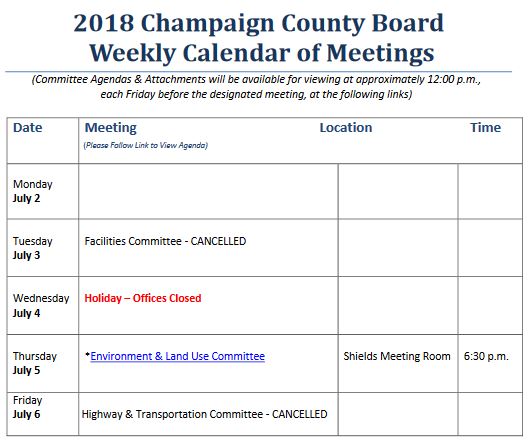
The only thing going on this week other than cancellations and a July 4th holiday closing to report is the Environment & Land Use Committee (agenda here). The committee will be receiving the Zoning Board's proposed rules on solar farms and performing the preliminary procedures to vote on them in August (more on that at this Cheat Sheet post). The Environment & Land Use Committee deals with environmental issues and how land is used within the County's jurisdiction.

The full 2018 schedule is on the Calendar page and the County page. The regular County Board meetings are back to Thursdays until next holiday season.

If you're curious about learning more about how your county government works, it's easy enough to live stream a meeting or go in person: Attend a Meeting.

http://www.co.champaign.il.us/CAL/2018/180701.pdf

*Meeting is broadcast live on Comcast Public Access and at http://www.ustream.tv/channel/champco1776


Where is Brookens?

Brookens Administrative Center
1776 East Washington Street
Urbana, Illinois 61802-4581
Phone: 217-384-3772

After 4:30 the Washington Street side Parking Lot is Closed See Maps for the North East Parking Lot Access


MTD Budget Increase


Thursday's News-Gazette had some budget numbers for the Champaign-Urbana Mass Transit District from their most recent board meeting:
MTD board approves budget with $10.7 million spending bump
Employee raises, capital projects and a liability insurance increase will help push next year's spending plan for the Champaign-Urbana Mass Transit District up by about $10.7 million.

The MTD board unanimously approved a budget for the fiscal year starting July 1 that includes a total appropriation of $56.4 million — roughly 19 percent more than the current year's $45.7 million.

A public hearing preceding that action opened and closed rapidly when there weren't any comments offered.

Most of the budget increase is reflected in capital spending, according to MTD Managing Director Karl Gnadt. That's largely linked to the MTD's hydrogen-fuel-cell project, of which a Federal Transit Administration grant is covering $1.45 million of the cost, he said.

The MTD expects to take delivery of two no-emission, hydrogen-fuel-cell electric buses by early 2020, Gnadt said.
More details, like a 2.75% raise for everyone, fares being unchanged,  and a breakdown of other spending priorities at the full article here. A quick overview of the grant announced jointly by Congressman Rodney Davis and CUMTD last year here. More information on the hydrogen fuel cell project from its page at the Center for Transportation and the Environment.

Thursday, April 26, 2018

CU-MTD Renews UIUC Program


For those familiar with navigating campus traffic, you're probably aware of the bus service the UIUC pays for to help manage the chaos. That program was recently extended. From the News-Gazette's coverage of the MTD board meeting this week:
MTD board unanimously approves extending deal with UI until 2021
A 29-yearlong agreement to provide regular bus service to University of Illinois students, faculty and staff will be extended three years under a unanimous vote of the Champaign-Urbana Mass Transit District board Wednesday.

Under the intergovernmental agreement that runs until June 30, 2021, the UI will pay the transit district $5.53 million in the first year, $5.68 million in the second and $5.81 million in the final year of the contract.

The partnership was formed in 1989, a memo to MTD board members said, to provide safe, evening transit service for students and to meet the campus administration’s desire to avoid more and bigger parking decks...

 Also Wednesday, the MTD board agreed to pay $168,070 to Feutz Contractors for construction of a sidewalk linking MTD administrative facilities at 1101 E. University Ave., Urbana, with its new CDL training facility at 1207 W. University Ave., U.

And MTD Managing Director Karl Gnadt said an open house would be held next week to gauge interest in an on-demand transit service in southwest Champaign.

The hearing will be from 5 to 7 p.m. May 2 at Champaign Fire Station No. 6 at 3911 W. Windsor Road, Champaign, to see whether residents in an area generally bounded by Kirby Avenue on the north, Rising Road on the west, Interstate 57 on the east and Windsor Road on the south would be interested in the service. Under the plan, riders would use an app to request a trip in a small van to one of three destinations: the Stephens Family YMCA, the MTD transfer point on Round Barn Road or a regular MTD bus stop in southwest Champaign.
Full article here.

Thursday, March 29, 2018

Road Worrier and MTD Updates

The News-Gazette had a general bad news report on the state of the State of Illinois' roads, with some local highlights.
Rough road ahead

Among the nuggets of local interest included in a report issued Wednesday on the state of Illinois roads:

1. Fifty-five percent of major locally and state-maintained roads in the Champaign-Urbana urban area are in poor or mediocre shape. That includes 24 percent in poor condition and 31 percent considered to be mediocre.

2. Ten bridges (20 feet or longer) in the broader C-U area are considered to be structurally deficient, meaning there is significant deterioration of the bridge deck, supports or other major components. Those bridges may be posted for lower weight limits or closed if their conditions warrant.

3. The C-U area had the second-lowest annual cost per driver, $299, linked to traffic congestion among six urban areas in the state. That cost was lowest in Springfield and highest in Chicago.

4. In terms of time lost, traffic congestion in the C-U area added 13 hours of delay per year for the average driver.

5. In addition to annual congestion-related costs, drivers in C-U incurred $544 in repairs and other extra vehicle operating costs as a result of driving on deteriorated roads and $629 in added costs related to road features that impact safety, such as the number of lanes, lane widths, lighting, lane markings, rumble strips, shoulders and guardrails.
Full article here. The print edition referred to some local official commentary on the road damage from the MTD and others, and I believe they're referring to this article from yesterday: Cities' road-maintenance funds don't stretch as far as they used to

From the MTD meeting:
Proposed Illinois Terminal expansion loses out on federal grant funds
The proposed expansion of the Illinois Terminal in downtown Champaign — part of a larger downtown redevelopment plan potentially worth $150 million — didn't win any of the $500 million available this year in federal TIGER grant funding, Champaign-Urbana Mass Transit District Managing Director Karl Gnadt said Wednesday.

But other options remain to help fund the project, he said, including a second federal grant program known as the Bus & Bus Facilities Infrastructure Investment Program, via the Federal Transit Administration...

Also at Wednesday's monthly MTD board meeting, Gnadt said that the MTD's Token Transit app, which enables users to purchase rides online with a credit or debit card, would go into effect Monday.

The app is available for download, he said, but purchases can't be made until Monday.

They can be bought in any denomination, from a single ride to an annual or monthly pass.
That full article here.

Tuesday, March 20, 2018

Vote! Free Rides and Turnout So Far


If you haven't voted already today is the March 20th, 2018 Primary. Voting locations and sample ballots can be found at the County Clerk website here. If you still need to register, information on Grace Period Registration offered at all voting locations is here. Candidate information on the Cheat Sheet has been organized in this post. Check out the Champaign County Voters Alliance Candidate Guide for more information.

CU-MTD and some candidates (jump below) are offering free rides to the polls. From the News-Gazette:
MTD offering free rides to the polls for Tuesday's primary
The Champaign-Urbana Mass Transit District is offering free rides Tuesday for all voting-related activity.

The MTD announced the free rides as a way of encouraging civic participation.

"We're doing this to encourage good citizenship," said MTD Managing Director Karl Gnadt, who noted that riders would be on the honor system in terms of claiming that they're on the way to vote.

All bus rides throughout the district will be free from the start of service Tuesday until 8 p.m.
Full article here.

Turnout has been high and lopsided in early voting thus far. How much of that will be in addition to election day voting or merely instead of it remains to be seen. Also from the NG today:
Primary Decisions: Early voting heavy in Champaign County
Two weeks ago Champaign County Clerk Gordy Hulten predicted that as many as 5,000 primary election votes would be cast in the county. Monday morning he revised that number to “close to or over 10,000.”

But by Monday night the number was 10,065 votes already tablulated -- more than three times the total of 3,178 pre-Election Day votes in 2014, the last non-presidential primary in Champaign County. Still, he said he’s not ready to say that the overall primary election turnout will be as great as the 23,299 votes cast in 2014.

“That’s the big question because does early voting and voting by mail, if it’s really heavy, mean that Election Day will also be heavy? Or are we merely shifting Election Day turnout to voting early and voting by mail?” he asked.

There is no doubt, though, that Democratic early voting is up substantially.

About two-thirds of the people who had voted through Monday in Champaign County had chosen Democratic ballots, a remarkable reversal of historic trends.

Generally, Republican voters outnumber Democrats in non-presidential primary years by about 2-to-1. In 2014, for example, 63 percent of primary voters took Republican ballots. In 2010, it was 65 percent Republican.
Full article here (link will be updated).


Candidates offering rides:

This is not an exhaustive list, just what I've seen thus far. I'll add as I see more.

Jon Ebel on his facebook page:

https://www.facebook.com/jonebel4congress/photos/a.288398768327547.1073741829.229030640931027/359975341169889/?type=3

Betsy Dirksen Londrigan on her facebook page:

https://www.facebook.com/BetsyDirksenLondrigan/photos/a.1944873219129922.1073741828.1934273516856559/2065564353727474/?type=3


Thursday, January 18, 2018

BPNJ: Old Challenges, New Opportunities

The New Year brought a good crowd out to the Build Program Not Jails meeting at the IMC last night, including County Board member Chris Stohr (D – District 10) who has worked with the local criminal justice system as a mental health counselor at the jail. He was among many residents and students who came out with an interest in a more just and supportive community, rather than one that’s just part of the mass incarceration problem in America.

They discussed the Bail Reform Act which replaced a previous system that was easier for judges to ignore and ineffective. There was a recent presentation by States Attorney Julia Rietz and Sheriff's Office Chief Deputy Allen Jones at the last County Board Committee of the Whole. It is state legislation that affects the county in some ways, but in others the county had already implemented reforms on their own. The presentation video is twenty five minutes (direct link here) followed by questions from the board beginning at roughly the hour mark here.


https://youtu.be/wajUWY1fE6E?t=34m48s

They discussed the recent quashing of thousands of warrants by Judge Difanis for lesser offenses. The move was seen as a benefit for low income folks who'd have difficulty paying and only more so if jailed for non-payment as opposed to any danger to the community. The News-Gazette has more information on that here: Judge 'quashed' thousands of warrants.

They mentioned an interest by County Board member Robert King, who sits on the justice and social services committee, in ensuring the Racial Justice Task Force recommendations are carried out and not forgotten. Public input, pressure and accountability will be necessary to ensure positive changes in the future. BPNJ appears more than motivated in that regard.

They discussed ideas for collaborations with CU Citizens for Peace and Justice and its Courtwatch program and the desire to inform the public of the realities of the criminal justice system here, with a concern for privacy and other legal issues. Courtwatch has volunteers that attend criminal trials as members of the public to observe and at the request of defendants.

The recent homelessness panel was discussed and its focus on local business concerns which had the effect of sliding into more of dealing with the nuisance than assistance. Shelter accessibility, distances/bussing, strict controls, and forced detox issues were discussed within the group. Winter services and access in general were discussed. CU-MTD has a list of some warming centers and other winter services here.

Issues with housing discrimination and felony convictions, including work to end a Champaign ordinance that makes such discrimination legal and extremely problematic. Urbana appears to have an ordinance to protect from such discrimination, but there are issues with enforcement. Research on landlords raised questions on 49 of them.

Life intervened and I had to leave early, but they continued working towards a new year full of some of the same stubborn problems with ensuring justice over mass incarceration. New opportunities to collaborate with other groups locally and in the region as well as local elected officials taking an interest in ensuring the RJTF recommendations become reality instead of forgotten ring in the new year. Jail populations are down and no new jails were built after constant and passionate work by this group. If you're interested in joining them, come on out to the next meeting at the IMC, January 31, 2018, at 7:00PM.

Wednesday, December 20, 2017

Nursing Home Lawsuit and County Board Summary

[UPDATE 12/22: Notes from the meeting added below (jump to here). Also the County Clerk uploaded the video, available here: https://www.youtube.com/user/champaigncountyclerk ]

In the ever dire news of the Nursing Home debt, a vendor is suing over a chunk of the roughly $2.7 million owed to vendors overall (not including subsidizing loans from the County or other budget issues). Excerpt from the N-G:
Former county nursing home vendor sues over $235,000 in unpaid bills

A Pennsylvania-based company that once provided dietary and housekeeping services at the Champaign County Nursing Home has filed suit against the nursing home and the county, alleging breach of contract and asking to be paid about $235,000.

Health Care Services Group of Bucks County, Pa., filed the lawsuit earlier this month, saying that the nursing home was behind in its payments.

According to the suit, the nursing home was to pay HCSG $60,955 a month for services provided. But as of Oct. 31, the suit said, the county owed the company $234,622.

Last week, in a report to the county board, County Auditor John Farney said that HCSG had been owed $234,610 on Nov. 8 but that by Dec. 12, the sum had been reduced to $182,278 after a payment on Nov. 29.
In the County Board meeting, the N-G had a summary, excerpts with a quick run down quoted below:
Champaign County Board OKs hiring law firms to sue opioid makers

Champaign County Board members voted unanimously Tuesday to join other Illinois counties that have hired law firms to pursue claims against drug makers believed to be partly responsible for the nation's opioid crisis.

The 21-0 vote came without debate.

Under the agreement, three Illinois law firms will split 25 percent of the gross amount recovered on behalf of the county...

Meanwhile, the board deferred action until January on two items related to the county-owned nursing home.

One was to renew $500,000 in loans from the county's general corporate fund to the home. The original terms said they had to be repaid by Dec. 31.

The second item calls for the issuance of more than $1 million in tax-anticipation warrants —essentially short-term loans to be repaid with property-tax revenue in the spring — to help the nursing home's cash-flow problems.

Champaign Republican Jim McGuire said he asked for the deferral on the nursing home issues because "we just need more time to accomplish some things. There is a lot going on in the background, and we just weren't ready tonight."

"We're discussing things and working together to get some things accomplished," McGuire said. "Some financial issues have come up, and we're just waiting to see what happens. We're trying to settle things down. We're getting there, but we're not there yet, so in January we hope to get some things accomplished."

Board members also approved, 19-1, the county's participation in an application to establish a land bank that advocates say would be a more efficient way of acquiring blighted properties and redeveloping them. The village of Rantoul is the lead agency in the application to the Illinois Housing Development Authority, along with the cities of Champaign and Urbana and the county. One goal of the land bank, said county zoning director John Hall, is to make the agency self-sustaining.

Also Tuesday night, the board approved the appointments of Richard Barnes of Urbana to the Champaign-Urbana Mass Transit District board; Susan Fowler and Thom Moore, both of Champaign, to the county mental health board; and county board Republican Diane Michaels of Rantoul as the new county auditor, effective Jan. 1. She succeeds John Farney, who will become the county treasurer, replacing Dan Welch, who is retiring after 19 years in that position.

Also, the board named a five-person committee to review the upcoming transition to a county-executive form of government. Champaign County will elect a partisan county executive next November, and the powerful position will become effective in December 2018. Appointed to the committee were Democrats C. Pius Weibel, Kyle Patterson and Steve Summers, and Republicans Jim Goss and McGuire.

Board member James Tinsley, an Urbana Democrat, was absent from Tuesday's meeting.

Amy's 12/19 County Board Notes:
The January County Facilities Committee meeting (scheduled for Jan. 2) was canceled. No public participation at this meeting. During the Communications portion, upcoming events that were announced include a January 12 Martin Luther King event at Vineyard Church in Urbana and a February 25 Art Fair organized by the Friends of the Champaign County Nursing Home.

During the Finance portion of the meeting, resolutions 10187 and 10188 both received a motion to defer the decision to January. Both times, the motion was raised by Councilman McGuire and passed on a voice vote.
Resolution 10186, Authorizing Purchases Not Following Purchasing Policy was for several thousand dollars in extra Nursing Home supplies (from janitorial, soap, etc) according to the full agenda. The motion passed.

Resolution 10191 Establishing a County Executive Style of Government Transition Committee was approved. Wiebel said that the committee would consist of Patterson, Summer, McGuire, Goss and Wiebel.

Three agenda items of the night received the most discussion.

The first was Environment and Land Use Resolution 10166 Authorizing Champaign County Participation in a Joint Application with Municipalities for the Illinois Housing Development Authority Land Bank Capacity Program. I believe that Esry gave the presentation and stated that the short notice to this request was due to a grant deadline of 1/15. This grant will offset the costs of creating an operating land bank to more efficiently address and dispose of damaged properties. Rantoul will lead the agency, with duties to include a feasibility analysis, developing operational plans, and initiating the land bank. It is anticipated that the agency will become self-supporting through income from the land bank with no cost to the cities involved. Questions were raised to Mr. Hall (Head of Planning and Zoning Department) regarding whether or not a board would be established and questions about liability issues.

The second were the Rural Transit Service Report for FY2017 and the approval of a Budget Amendment for State Capital Grant toward Intelligent Transportation Systems (ITS) Software to improve services. Zoe Keller reported on the implementation and growing ridership of the Rantoul Deviated-Fixed Route, available for just over a year.

The third was regarding Resolution 10195 to pursue claims against opioid manufacturers. This was pretty well covered by the News Gazette. The only addition that I’d add is, as Council member Furtado pointed out, this request is rather timely given last week’s COW approval of additional funds to the coroner’s office needed to fund, in part, the increased number of tests for an ever-changing range of opioid compositions on the street.