Friday, July 20, 2018

County Board 7/19

Reminder: Last month's County Board meeting is available on video now at the County Clerk's YouTube channel for those waiting for it. This month's video is already up and available here.


Last night's County Board meeting saw another failure to consolidate the County Recorder's office into the Champaign County Clerk's office.  From today's News-Gazette:
Champaign County Board votes to keep recorder around
In July 1968, Democrats on the Champaign County Board proposed eliminating the independent elected position of recorder of deeds.

The elimination never happened.

Exactly 50 years later, another generation of county board Democrats proposed the same thing.

And once again, it won't happen.

On Thursday night, the county board voted 15-7 against putting a question on the November ballot asking for the elimination of the office.

Five Democrats joined all 10 Republicans to ensure the status quo...

In other business, county board member Robert King said he will be resigning because he is moving to upstate New York, where he will work with students at Cornell University in residential programs there.

"I absolutely have enjoyed my time on the county board," King said. "I had a chance to work both with folks with the same opinions and differing opinions, and it has been great."
Full article here. According to the County Clerk, County Board member Shana Jo Crews, a Democrat representing District 9 also resigned last night. This page will be updated soon to reflect those changes and any appointment or election updates that result.


Meeting overview:

Public participation started with a couple Scottswood development residents pleading for more assistance in cleaning up their neighborhood. Two citizens explained their efforts towards encouraging better maintenance and organizing a low cost neighborhood mowing service to help those efforts.

County Recorder Mark Shelden made his argument to keep his office elected and separate from the County Clerk's office. He argued that his office is running effectively as is and the proposed changes couldn't be absorbed as explained by proponents of consolidation. He explained that simply replacing him with a lower paid staffer wouldn't work unless quality was reduced or other responsibilities of the County Clerk and staff suffered. Meanwhile the Democratic County Executive candidate Darlene Kloepel argued it made fiscal sense and was an unnecessary complication and expense for voters.

The Reentry Council Report was filed without any significant discussion. Member Petrie noted that she had some additional questions she'd be taking up with the Council. That report is available here on page 14 of the agenda packet PDF (page 9 on the printed version).

The Agenda items were generally passed unanimously and with little significant discussion outside of the Recorder's Office vote. The other exception was an question and answer session with a guest from the Regional Planning Commission about a criminal justice related grant and program (that required Board approval to go ahead). There weren't a lot of specifics yet as the project will be entering the planning phase in the near future. Board members pushed for specifics, but the RPC representative only had broad information at this time. The general consensus was that this was an important and positive victory for the County and appreciation was noted for the hard work behind the competitive grant process (RPC is only one of 41 organizations awarded the reentry funds). The program description (from the agenda XIV. New Business, Item 4.) lays out the general idea:
Multi-Year Federal Funding to Service Over 188 Young Adults Ages 18-24 Who Reside in High Crime & Poverty Census Tract Areas in Probation, Court or Detention or are High School Dropouts. Based on the Needs of the Target Population for the Project, Evidence-Based Interventions and Practices will be Implemented Including Cognitive Behavioral Therapy, Structural Psychotherapy for Adolescents Responding to Chronic Stress, Intensive Mentoring & Development of Support Groups, Job Coaching and On-the-Job Training and Development of Apprenticeships in Building Trades. RPC & Community Partners will Utilize a Positive Youth Justice Framework that will Guide Development of Career Plans and Case Management to Positively Impact Employment and Reduce Recidivism Rates with High-Risk Young Adults.
More updates on this program as I find them.

There was an item authorizing more appropriations for litigation costs with the Carle Property Tax issue. Petrie and Administrator Busey discussed the complexities that prevent a full accounting of the County Costs as the issue is intergovernmental and multifaceted. There doesn't appear to be a way to track to compare costs to potential gain back to the county if successful.

The Recorder vote had a quick amendment attempt to change the starting date of the change to the end of the election cycle for the office (2020 instead of 2018 in the current wording for the referendum). That failed in a tie vote 11-11. The motion itself failed 7 to 15. I believe the yes votes were Patterson, Summers, Tinsley, Crews, Douglass, Fortado, and Chair Weibel. I was expecting a bit more argument, but folks seem to have gotten that mostly out of their system last month.

McGuire thanked all those who volunteer and work on the elections in relation to their approval of Election Judge appointments. They truly make this whole crazy democratic institution function. 

Petrie thanked Deputy Administrator Ogden for all her hard work on the ADA report to the Department of Justice (with additional information available at the very end of the agenda packet).

The Board went into closed session about a county employee/employment issue prior to adjourning.

Champaign County Crimestoppers Award

[UPDATE - The News-Gazette had additional photos and details of the event they published on August 12th and available in their eEdition here.]

Champaign County Crime Stoppers awarded a local Central High School administrator for running towards the sound of danger to usher people to safety. From today's News-Gazette:
Crime Stoppers honors Central admin for actions during shooting
Brandon Thomas and Bryan Yacko were doing what they had done countless Friday nights before at Champaign Central High School — keeping a watchful eye on the crowd leaving after a basketball game.

But for the Champaign police sergeant and the assistant principal, Dec. 15, 2017, differed markedly from previous Fridays — when gunfire outside the 83-year-old school building created fear in the departing crowd and wounded three young people.

As Thomas, the police sergeant, ran with other officers toward the shots, Yacko the educator, radioed to coworkers about what was happening, then headed toward the shots to direct people back inside to safety.

For his quick thinking and action, the 38-year-old Yacko was honored Thursday with the Dave Benton Crime Fighter of the Year Award by Champaign County Crime Stoppers at its annual meeting in Savoy.

The award is named in honor of the late television anchorman who served on the Crime Stoppers board for many years prior to his death in 2015.
Full article here.

Area Transportation Lab


There's a place in Champaign County where local government, State government and our area University, renowned for engineering, are collaborating in ways that may affect local government transportation options everywhere: The Advanced Transportation Research and Engineering Laboratory. From the Wednesday News-Gazette:
UI's transportation lab in Rantoul could soon get test track, 'smart city'
...
Self-healing roads are just one of the innovative areas where the Illinois Center for Transportation is in the vanguard. And it's all happening in Rantoul.

The center is located at the Advanced Transportation Research and Engineering Laboratory, tucked away in the northeast corner of the former Chanute Air Force Base. Researchers from the University of Illinois and other universities in Illinois and nationwide, as well as the Illinois Department of Transportation, study transportation-related issues there.

And while it is already the place to be for transportation-related research in this area, it might get a lot busier.

The center, which sits on 47 acres of the former base ("Most people don't know we're out here," said Kristi Anderson, financial operations manager) could grow exponentially in size. A proposed project — housing a 1.9-mile test track where vehicles could reach speeds of up to 65 mph — would add 257 acres to the site.

"In the middle of the (site) will be a smart city with different opportunities to test different types of transportation," she said...

The UI's lab spans 67,000 square feet of laboratories with three main buildings. The center's accelerated transportation loading system enables researchers to evaluate different transportation systems "under real environmental and loading systems, whether it be trucks, aircraft or rail systems," Anderson said.

Its mission includes implementation of technologies that improve safety and reliability, reduce congestion and impact on the environment.

IDOT is one of the center's largest sponsors. Since 2005, it has contributed $77.2 million worth of funding for the facility.

The new smart transportation initiative, under the UI College of Engineering, will focus all transportation research under one umbrella, pulling together academia, government and industry, Anderson said. Its mission will be to accelerate development and deployment of automated transportation with a focus on freight and autonomous vehicles. The UI, Northwestern and University of Illinois-Chicago are assisting with the project.
More at the full article here.

Solar Farm Tour


The Champaign County Sustainability Network (or CCNet) had a presentation and tour of the U of I solar farm yesterday and brought out a lot of folks interested in the new county rules on solar farms. The County Board will be voting to implement those rules next month after the 30-day review period required (more on that at this Cheat Sheet post). For a quick peek at the presentation, they provided a fact sheet and slide shows from the presentation:
Agricultural Impact Mitigation (protecting the topsoil for later use) was brought up by County Board member Pattsi Petrie who was in attendance and a discussion ensued about panel spacing and the effect on areas that get less moisture over time. There appeared to be more questions than answers on this issue at this time, however. On the tour the ground cover of plants was uniform, though growth was did appear stunted a bit under the panels compared to in between.

Morgan White, the facilitator of the presentation and tour, was asked about County rules, but it did not appear that the University was following the County's work on that closely. Petrie noted the 30 day review period and emphasized the boards need for input.

A lot of the details that were discussed can be gleaned from the Fact Sheet. There was some discussion about the co-generation of both steam being used for heating as well as to drive turbines for electricity and a brief overview of the chilled water system (odd factoid: apparently the chilled water generators are partially steam driven, though they prioritize electric powered chillers).  They have a thermal energy storage tank to help deal with intermittent power issues from energy sources such as solar that vary. The University also has a wind power purchase agreement with another site and multiple smaller solar installations.

They also discussed some other sites and projects from a biomass boiler that allows for field to flame on-site handling of material and energy production. Research and testing sites are scattered around the area, such as the Solar Decathlon House which is available for conferences.

Land use efficiency came up, especially as it applies to spacing required for optimal fixed tilt. The optimal tilt of a single row versus multiple and the cost benefit limits of variable tilt panels were discussed. Reduction of efficiency of solar panels over time were discussed in the context of long term viability. The gist appeared to be that over a long period of time the units would still produce significant electricity, but with less efficiently in regards to cost per kilowatt as well.

Noise was discussed. The primary source of noise come from the cooling units on the inverter cabinets (where all the direct current electricity from the panels runs to and is converted to alternating current for the grid). The rural units we saw on the tour weren't insulated for sound and were similar to the noise you'd hear next to any small commercial building's rooftop AC unit. For a city dweller it may not be very annoying or noticeable depending on your situation/proximity. For folks wanting a quite country existence with nothing but the sound of nature, some sort of sound dampening and distance would probably be required. A quick video with me speaking a couple feet from the microphone at an indoor voice level (adjust volume up to hear background versus voice noise):


The inverters tend to be centralized in the middle of the panel rows for electrical and logistical reasons. In this case they're along a column road for access, down the middle of the solar farm.

There were some questions about the solar farm having an extended down time recently. This was apparently due to a parts backlog after the hurricanes last year causing a dramatic wait. Only one inverter was affected, but as they ran in series, that took the whole farm offline. The design has been modified to allow partial use in similar scenarios in the future.

The University appears to be going by the assumption that they will purchase the farm and continue to use it (and have first rights to do so) after the 10 year contract and perhaps even 25 years out. At that point it comes down to future circumstances and how cost effective it is to keep. The University therefore doesn't have any immediate concerns about decommissioning costs that the County Board does and that Petrie raised during the presentation.

When it comes to other environmental concerns like pollinators or pollinator improvements, this site is generally controlled by the vendor on those issues, though the University can encourage such improvements. They are looking at those issues more in depth for a future solar farm expansion, however. (more on pollinator issues on the Cheat Sheet here).

There was a discussion towards the end of the presentation about land use efficiency, both in the context of killowatts produced, but also economic and agricultural production. Wind farms do take up space around each turbine that adds up, even though it's spaced out, whereas solar farms are necessarily condensed in their land usage. Wind has overall advantages here, but the disadvantages are that wind blows more at night and more in winter... which aren't peak electrical usage times, generally. Proximity and ability to connect to the grid plays a role as well.

Thursday, July 19, 2018

People's Hearing on Middle Fork Toxic Spill

[UPDATE - In national news directly related to toxic coal ash regulation from Reuters yesterday:
U.S. EPA eases Obama-era standards on toxic coal ash
The U.S. Environmental Protection Agency said on Wednesday it has eased Obama-era standards on the disposal of toxic coal ash, a move expected to be the agency’s first revision of the standards and one that was slammed by environmentalists.

The 2015 rule established minimum national standards for the disposal of coal ash, a byproduct of coal-fired power plants that contains materials such as arsenic and lead.

The EPA said the revision would give flexibility to utility companies and states, which had fought against the standards calling them unduly burdensome, and save $28 million to $31 million per year in regulatory costs...

Under the new rule, state and EPA officials will be able to suspend groundwater monitoring requirements at coal ash sites if it is determined there is no potential for pollutants to move into certain aquifers. The rule also extends the life of some coal ash ponds from early 2019 to late 2020.

Coal ash is stored at hundreds of power plants throughout the country. Spills in Tennessee and North Carolina leached sludge containing toxic materials into rivers in those states over the last decade...

The EPA said on Wednesday it plans to propose other changes to the 2015 coal ash rule later this year.
Full article here.]


A "People's Hearing" on Monday June 11th will be held to get public input and inform the public on the coal ash pits seeping toxic chemicals into the Middle Fork River. More information is available at their facebook event page and they also had a blurb in the News-Gazette recently:
People's Hearing to Protect the Middle Fork
It's Our River!  Let's Protect It.
Join neighbors and friends at the June 11 People’s Hearing in Danville. Now is the time to call on the IEPA and Governor to protect the state’s National Scenic River by ensuring the removal and relocation of coal ash to a properly-constructed, monitored landfill away from the river. Coal ash includes toxic heavy metals like arsenic, chromium, lead, manganese, and nickel that are known to cause birth defects, cancer and neurological damage in humans and harm and kill wildlife, especially fish.

Senator Scott Bennett, Vermilion County Board Chair Michael Marron, and Danville’s Mayor Scott Eisenhauer will preside over the meeting. The hearing will include a ten-minute overview of the problem and solution under consideration before hearing from experts.
More event details and contact information at the full blurb here. There was also some background information on the issue and players from the News-Gazette yesterday:
Dynegy faces federal lawsuit over coal-ash pits on Middle Fork
The Prairie Rivers Network, which hopes to force Dynegy to clean up coal-ash dumps along the Middle Fork River, filed a federal lawsuit Wednesday alleging that the power company is allowing harmful pollution to leach into the river upstream from Kickapoo State Recreation Area.

The lawsuit, filed in U.S. District Court in Urbana, asks the court to declare that Dynegy is violating the nation's Clean Water Act at its former coal-fired Vermilion Power Station along the banks of the Middle Fork and order the company to cease all unpermitted discharges of pollutants into the state's only National Scenic River, as well as pay civil penalties.

In January, Prairie Rivers Network and Earthjustice officials announced the filing of a 60-day notice of intent to sue Dynegy, which closed the Vermilion Power Station in 2011 — the same year that sampling from underground monitoring wells on the property detected levels of boron, manganese and sulfate in excess of groundwater quality standards.

The Illinois Environmental Protection Agency declared Dynegy to be in violation as a result of that sampling.

Though the power station has been shuttered for several years, three pits remain there filled with coal ash left over from decades of the coal-burning process. The ash contains contaminants, like boron, manganese and more, that can be harmful to the environment.
A lot more information, details and background at the full article here.

Following up on these previous Cheat Sheet posts: Local River Endangered (4/10/2018), More Coal Ash News (3/2/2018) and Coal Ash Cleanup in the News (2/9/2018).


[This post originally published on 6/1/2018 at 4:43pm]

County Board and the Recorder Preview


Whether or not the County Recorder's office is superfluous and its duties made part of the County Clerk's office doesn't seem like a political question. Would it be cheaper? Yes. The office is self-funded now and would be if it was happening under the Clerk's office too. There's an honest discussion to be had on whether having a separately elected head of the office is necessary or just more complications in local governance. But the seat is held by a long time Champaign County Republican Party politician and party player. These types of seats are often used by political parties to springboard careers. Each party's partisans will happily explain how they're being the rational and objective ones here.

I leave it to the reader to decide whether one side, the other, or both are playing politics. More importantly: whether it's relevant to the key question of whether they find the extra elected office necessary to ensure the Recorder honestly performs his duties, or whether holding the County Clerk accountable would be sufficient. Use the links on this page to your County Board members to let them know how you feel. From the News-Gazette today:
Round 3: Recorder’s job back on agenda
...
Tonight, the board is expected to vote on whether to put a binding question on the November ballot asking voters if the recorder’s office should be rolled into the county clerk’s by December.

That’s a change from the original proposal, which called for nixing the office in 2020 — the end of Recorder Mark Shelden’s four-year term.

Shelden, a Republican, said his office funds itself through recording fees. He added that he knows of only a couple of people who support the change.

This will mark the third time in five years that the board has considered this measure. Democrat Shana Jo Crews, who could not be reached for comment, is leading this push.

When the subject came up at a board meeting last month, Republican member Jon Rector called it “borderline ridiculous” and “totally political.”

Interim County Administrator Deb Busey said eliminating the position would save $60,000. Busey said only 13 other Illinois counties — including Vermilion — have a recorder.
The full blurb is available here. The County Board meets tonight at 6:30pm (agenda here). If you'd like to attend a County Board meeting, you can find more information on how to attend here. Probably one of the more contentious items is the referendum proposal to merge the County Recorder's office into the County Clerk's office. The current Recorder is Mark Shelden, prominent in Champaign County Republican Party politics, so there are concerns by Republicans that this is more political than reformative. The vote to put it on the ballot was delayed and discussed at the last regular County Board meeting.

UPDATE: From the News-Gazette after the vote:
In July 1968, Democrats on the Champaign County Board proposed eliminating the independent elected position of recorder of deeds.

The elimination never happened.

Exactly 50 years later, another generation of county board Democrats proposed the same thing.

And once again, it won't happen.

On Thursday night, the county board voted 15-7 against putting a question on the November ballot asking for the elimination of the office.

Five Democrats joined all 10 Republicans to ensure the status quo.
That full article is available here with some the details about cost savings versus concerns about keeping the office independent as well as some of the political and partisan realities.

UPDATE: 10/22/2019: The issue appears to be coming up again with the 2020 election. More on consolidation at a recent post here: Merging County Clerk and Recorder

Tuesday, July 17, 2018

Law Enforcement Supporting Special Olympics

Local law enforcement will be supporting efforts to raise money for the Illinois Special Olympics next week. From the News-Gazette today:
Fundraising lunch to benefit Special Olympics set July 26 at Texas Roadhouse
Police officers from all over Champaign County are inviting people to eat lunch at Texas Roadhouse on July 26 to benefit Special Olympics Illinois.

From 11 a.m. to 2 p.m., officers will serve a pulled-pork sandwich, corn, fresh-baked bread with honey-cinnamon butter and a non-alcoholic beverage. Diners are asked to leave a donation for their meal, which is valued at $10.

Diners also have a chance to win a free dinner for two at Texas Roadhouse by posting a photo from their location on social media using the hashtag "#IGotServed."

Donations benefit the more than 22,500 athletes with intellectual disabilities who participate in Special Olympics Illinois. The Law Enforcement Torch Run is the single largest year-round fundraising vehicle benefiting the group.
Additional activity and event details here.

Clear Cutting by Drainage District


In a recent clash between county homeowners and an obscure local government body, a large section of trees were clear cut unexpectedly on the property easements. From the News-Gazette today:
Drainage district's clearing work on Salt Fork leaves some residents floored
...
Property owners learned the work had been ordered by the Upper Salt Fork Drainage District, a local body governed by three elected commissioners.

Drainage districts are authorized by state law to levy an assessment on all landowners within them to cover costs of maintaining and improving drainage, which in the Upper Salt Fork includes about 21 miles of waterway, stretching from Rantoul to about 3 miles south of St. Joseph, where it empties into the Salt Fork. It passes by Heather Hills.

Drainage districts also have a right of way, allowing them access to properties to maintain drainage. The Wardrops said they and their neighbors aren't certain how far from the bank that right of way extends.

Regardless, they are upset that no one bothered to contact them before the clearing was done. But they say they're not sure whether the district is required by law to notify landowners if work is deemed "maintenance..."

As to whether the clearing would alleviate that problem, Weckel said, "It can't hurt."

But he said there are too many miles of limited flow to the south of those properties. The ditch flattens out along that section, he added, stalling the water flow north of St. Joseph. South of town, it picks up where the ground falls at a steeper rate, according to Weckel.

"But it is relatively flat through there, and that's the problem," he said. "There's just not enough fall to keep the water moving."
More at the full article here. The Prairie Rivers Network had a long and detailed post on the subject. Here's a short excerpt:
After discovering workers clearing their land and what appeared to be a rudimentary road on their property, a few homeowners reached out to Upper Salt Fork Drainage District commissioners requesting an explanation of why work was being done without notice. It was explained that the work was routine maintenance to remove trees that had fallen into the waterway. Further calls from landowners to the drainage district were reportedly ignored or answered with hostility.

PRN called various government agencies and was told that the trees were causing flooding and the work was reportedly done to reduce flooding in the neighborhood.

These stories don’t necessarily line up. Was the goal to remove trees that had fallen in the river, or was clear cutting the riverbank itself the goal? Given the conflicting explanations and no work plan, we are left to wonder why the Drainage District thought this was a good idea.

If the work truly was for maintenance removal of fallen logs from the river, the Upper Salt Fork Drainage District went about it in an aggressive, devastating, and seemingly unnecessary way. The district downed many live trees, displaced wildlife, and destroyed a good portion of what little natural habitat remains on that section of the Salt Fork. If the purpose was to access fallen trees in the river, the other side of the river provides easier access from grassed farmland with just a few trees.
More at the full post here.

Deer Archery Rules Change


New rules on archery deer hunting from the DNR in Champaign and neighboring counties are being considered. More on why the rules are being proposed by the Illinois Department of Natural Resources in a report on their website here. From the News-Gazette's Sunday eEdition:

Deer archery season changes
A proposal to restrict archery deer hunting in Champaign County to bucks only the first two weeks of the season is still making its way through the state rulemaking process, according to Ed Cross with the Illinois Department of Natural Resources. But IDNR has posted a document on its website with interesting details about why this change is being considered here and in four other counties — Douglas, Macon, Moultrie and Piatt.

Basically, these agriculturally dominated counties have little forested area — less than 5 percent — to support a large deer population to begin with, and the number of deer continue to decline, according to state officials, despite significant reductions in gun permit quotas.

The report — which can be accessed on IDNR’s website — says that Champaign’s deer population is 35 percent below goal...

Managing the deer population in other parts of the state is typically done by adjusting deer permit quotas during the firearm and muzzleloader seasons, but in Champaign County and the other four, state officials have decided the best way to get deer population numbers back up will be restrictions at the beginning of the archery season.

According to the report, “IDNR biologists have decades of harvest data and hunter success data to guide their decisions,” and this “preferred approach is simple: allow only the harvest of antlered bucks during the first 15 days of the archery season (Oct. 1-15), which will reduce doe harvest by 25-30 percent,” which should be enough of a reduction to move populations back toward goal.”

Here’s the proposed amendment: “The Illinois Restricted Archery Zone shall consist of Champaign, Douglas, Macon, Moultrie and Piatt counties. During the period Oc. 1 – Oct. 15, only antlered deer may be harvested in the Restricted Archery Zone, regardless of permits in possession. An antlered deer is defined as a deer having at least one antler of a length of 3 or more inches.”
Full article available here for subscribers.

Solar Farm Locations


Tom's Mailbag had a short bit on proposed solar farm locations as the County appears set to change the zoning rules to allow them in certain agricultural zones. From Saturday's News-Gazette:
Solar farms in Champaign County

"With regard to the proposed changes in zoning to allow solar farms in the county, is there a map of the proposed locations, and a list of the companies that have made the requests available?"

No, there is no map of the proposed locations, said John Hall, the county's director of planning and zoning.

"But the general locations and companies are as follows:

— "three solar farms have been proposed near St. Joseph (companies are ForeFront Power and Community Power Group)

— "three solar farms have been proposed near Sidney (companies are Forefront Power, BayWa r.e., Cypress Creek Renewables)

— "one solar farm has been proposed northwest of Rantoul (Community Power Group)."
The full Mailbag article is here and covers a variety of local questions.

The Week in Progress 7/15 - 7/21

*** There is a County Board meeting this Thursday. Agenda here. If you'd like to attend a County Board meeting, you can find more information on how to attend here. The issue of merging the County Recorder's office into the County Clerk's office is on the agenda. ***

Previous County Board video is available now on the Champaign County Clerk's YouTube channel here. Agenda packet available here and news coverage here.


Other Events:

There are a lot of political campaign and organizing events popping up. Check out your preferred candidates and you will likely see campaign, canvassing, or voter registration events in the area. Many are using facebook to more easily share event information and reminders. Check out the Champaign County Voter Alliance's preliminary general election candidate guide to see who is running. We'll be updating County race information from the primary election to the general as we can.
 
Groups that crossover with Racial Justice Task Force recommendations meeting this week:
Build Programs Not Jails doesn't meet this week. Meetings are every other Wednesday at 7pm at the IMC. The next meeting is July 25th.
Later this month — likely at the July 24th Champaign City Council Study Session (more info here) — there will likely be a presentation on the housing issue and the exemption (more information on that here and a recent letter to the editor by the CU Tenants Union here). Support among local organizations continues to grow. The Reentry Council will be reaffirming its long standing support of the measure as well (notes from their last meeting on it here).

The Housing Authority of Champaign County's new Executive Director reaffirmed the board's focus on expanding reentry opportunities in the community and the problems exacerbated when people with conviction histories are denied access to housing. He pointed out that HACC is still working with the Champaign County Reentry Council towards that end and he is reaching out to community organizations and government bodies in the area to work together on that and other issues.

County Calendar:

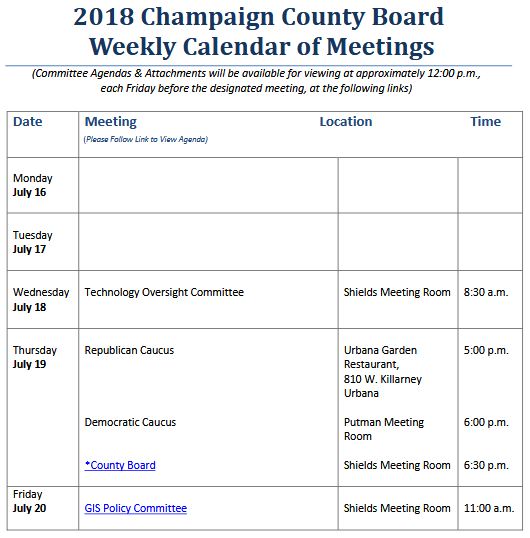
The week kicks off Wednesday with the Technology Oversight Committee. I don't have any information on exactly what this committee does. I believe it may be more of a management committee for computers and IT issues for staff in the various county facilities. More information to come on that.

There is a County Board meeting this Thursday. Agenda here. If you'd like to attend a County Board meeting, you can find more information on how to attend here. Probably one of the more contentious items is the referendum proposal to merge the County Recorder's office into the County Clerk's office. The current Recorder is Mark Shelden, prominent in Champaign County Republican Party politics, so there are concerns by Republicans that this is more political than reformative. The vote to put it on the ballot was delayed and discussed at the last regular County Board meeting.

The GIS Policy Committee meets Friday. The GIS talks maps and data, orthophotography, sewage systems, water permeability of soil and drainage and the intricate systems that allow a consortium of city and county governments, as well as private companies needing data. For more information about the GIS and what a meeting is like, check out this write up.

The full 2018 schedule is on the Calendar page and the County page. The regular County Board meetings are back to Thursdays until next holiday season.

If you're curious about learning more about how your county government works, it's easy enough to live stream a meeting or go in person: Attend a Meeting.

http://www.co.champaign.il.us/CAL/2018/180715.pdf

*Meeting is broadcast live on Comcast Public Access and at http://www.ustream.tv/channel/champco1776


Where is Brookens?

Brookens Administrative Center
1776 East Washington Street
Urbana, Illinois 61802-4581
Phone: 217-384-3772

After 4:30 the Washington Street side Parking Lot is Closed See Maps for the North East Parking Lot Access


Sunday, July 15, 2018

More Pollinators

Last month it was the U of I's Pollinatarium highlighting local pollinator concerns with solar panels and bees. This month it's migrating Monarchs! The News-Gazette had information from the U of I Extension (serving Champaign and other area counties) in yesterday's paper:
In the Garden | Supporting the monarchs
Each year, there are four generations of monarch butterflies in Illinois. The first generation is born when overwintering monarchs return to lay eggs on milkweeds in late April or May. Two more generations occur over summer with a lifespan of about two to six weeks each. The final generation, born around September, migrates to Mexico as fall weather begins to cool. This lucky generation of monarch lives for six to eight months as it overwinters and travels countless miles on the trip to and from Mexico. Since the overwintering monarchs do not expend as much energy on reproduction as non-migratory generations, they are able to redirect that energy into survival, extending their life.

The U.S. Fish and Wildlife Service is currently assessing whether the monarch needs protection under the Endangered Species Act. Their assessment is not scheduled to be completed until June 2019. In the meantime, conservationists, biologists, non-profit organizations, government agencies and others are rushing to implement conservation measures to stabilize the monarch population.

So, what can you do to help the effort? One of the most basic things we can do is add more milkweeds to our landscaping or preserve areas on our property that support milkweeds.

Roadside ditches are abundant in Illinois and do support a lot of milkweed plants. Historically, these areas have been regularly maintained with mowing, which impacts both milkweeds and monarchs alike. However, many organizations, such as IDOT and county highway departments, are becoming more aware of the importance of milkweeds and now target their mowing to avoid plants...

Recent research has identified another obstacle for monarchs. Many butterflies simply cannot find enough food along the migration route. Although caterpillars feed exclusively on milkweeds, the adult butterflies feed on nectar from flowers. So, adding flowers to the landscape is a huge help. Who doesn't like more flowers? However, many of the non-native flowers we plant do not provide food for monarchs. This is another reason why planting native species is especially important for the monarch and other pollinators.

As monarchs approach the cusp of being listed as endangered, every little bit we can do to help is much needed. My hope is that we can someday look back at monarch conservation efforts and tell a story of success, one of a species with an equally dramatic recovery as its current decline.
More at the full article here. More about creating Pollinator Pockets at the U of I Extension program.

Kickapoo Trail Collaboration


An update on the Kickapoo Trail collaborations (previous blurb involving State and County Forest Preserve District here) were in the News-Gazette yesterday and talked about more potential collaboration on the Kickapoo Trail work. This time with city, county, state, and private entities that could end up benefiting the whole community:
Urbana working with Carle on proposed Kickapoo Rail Trail expansion
Amid ongoing litigation between the city and Carle Foundation Hospital, Urbana Mayor Diane Marlin thinks the two entities should still collaborate, and a plan to expand the Kickapoo Rail Trail will allow them to do just that.

The plan requires a collaborative effort from the city and hospital, along with the Champaign County Regional Planning Commission and Urbana Park District. Carle is contributing $25,000 as a grant match to $100,000 from the Illinois Department of Transportation, which will allow the planning commission to conduct a feasibility study on expanding the rail trail.

The vision, Marlin said, is to expand the pedestrian and bike trail westward from its current terminus at the intersection of East Main Street and U.S. 150/University Avenue through the northern edge of downtown, the southern edge of Crystal Lake Parkand Carle's hospital campus, stopping at the intersection of Lincoln and University avenues, near the northeastern edge of the University of Illinois campus.

"If we can get this built, it will connect downtown with Crystal Lake Park, Carle, the University of Illinois and the eastern portion of the trail," Marlin said Friday. "It would be transformative for the city as a whole..."

Local and state taxing authorities have been in a years-long legal battle with Carle over property taxes. The state Supreme Court sent the case back to circuit court in 2017, when former Mayor Laurel Prussing was in office.

Marlin said that collaborating with Carle has been one of her goals since she was elected, which came later in 2017. She noted that the proposed trail expansion would allow Carle employees to easily go downtown for lunch.
More at the full article here.